7 AI Engine Optimization Tools Reshaping Search Visibility in 2026
Compare the best software for AI engine optimization in 2026, including visibility monitoring, technical checks, governed content workflows, analytics, and reporting.
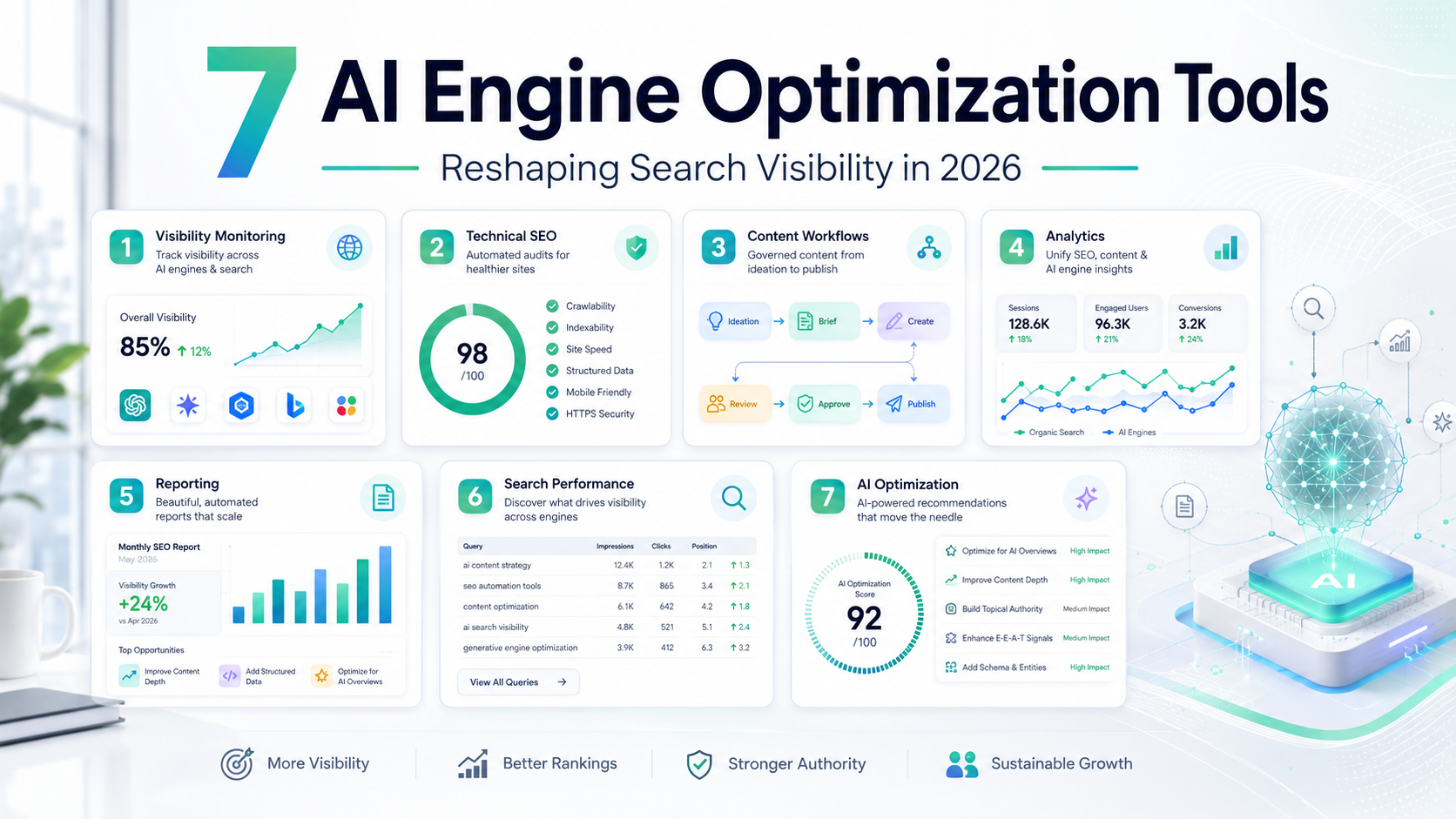
Search visibility is no longer limited to a blue-link ranking and a monthly traffic chart. Buyers now ask Google AI Mode, AI Overviews, ChatGPT, Gemini, Perplexity, and Copilot to recommend software, compare vendors, explain workflows, and shortlist solutions. That shift creates a practical new discipline: AI engine optimization, or AEO.
AEO is not a shortcut for forcing an AI model to recommend a brand. It is the operating practice of making a brand easy to understand, verify, retrieve, cite, and discuss accurately across traditional search and AI-assisted discovery. The best software for AI engine optimization in 2026 helps teams connect the entire loop: discover the questions that matter, monitor mentions and citations, publish genuinely useful evidence-backed content, check technical accessibility, and learn from results.
For marketing teams, founders, agencies, SaaS companies, PR teams, and SEO operators, the biggest challenge is not finding another dashboard. It is building a controlled system that turns signal into approved action. A visibility graph without content operations produces reports. AI-generated articles without review create risk. The stronger approach combines intelligence, execution, quality control, indexing checks, and measurement.
This guide compares seven important tools and tool categories, then shows how to assemble them into a practical, approval-gated workflow.
What AI engine optimization software should do in 2026
AI engine optimization software should help a team answer five questions:
- Where is our brand visible? Track mentions, citations, source pages, narrative themes, and competitive share of voice.
- Which buyer questions are we missing? Identify prompt, topic, comparison, and use-case gaps that competitors already own.
- Can AI systems and search engines access our information? Validate crawlability, indexability, internal linking, freshness, and structured page signals.
- What should we publish or improve next? Convert findings into briefs, page updates, comparison assets, FAQ hubs, and evidence-led product education.
- Who approved the claim and why? Preserve brand accuracy, compliance, product truth, and a decision trail before content or site changes go live.
The measurement model is different from classic rank tracking. AI assistants generate variable answers rather than stable positions. For that reason, useful programs monitor a portfolio of topic-level signals: mentions, citations, cited pages, prompt coverage, competitive gaps, sentiment or narrative context, referral traffic, crawl activity, index status, and qualified conversions. Ahrefs, for example, describes AI visibility through mentions, citations, estimated impressions, and AI share of voice, while warning that modeled visibility is potential exposure rather than a count of every private user interaction. (help.ahrefs.com)
Prerequisites before choosing a platform
Do not begin with a large prompt list or a generic request to improve AI visibility. Establish a small operating baseline first.
- A defined market: country, language, industry, customer segment, and priority product category.
- A brand-entity sheet: approved company description, product names, category language, differentiators, claims, executive names, pricing-policy rules, and prohibited language.
- A competitor set: three to six direct alternatives plus adjacent substitutes buyers may compare.
- A conversion map: the pages and outcomes that matter, such as demo requests, trials, pricing-page visits, product-qualified leads, or partner inquiries.
- An approval policy: name the SEO owner, editor, subject-matter expert, legal or compliance reviewer where necessary, and final publisher.
- A technical baseline: sitemap coverage, canonical tags, robots rules, server reliability, mobile rendering, internal links, and Search Console indexing data.
For example, a B2B SaaS company that sells onboarding software should not track only a vague prompt such as “best onboarding tool.” It should separate high-intent prompt families including “best employee onboarding platforms for distributed teams,” “employee onboarding workflow software with approvals,” “alternatives to [competitor],” and “how to standardize SaaS customer onboarding.” Each family maps to a buyer stage, a page type, evidence requirements, and a measurable business action.
The 7 AI engine optimization tools and capabilities to prioritize
No single product is automatically the best choice for every business. A small SaaS team may need a focused stack and disciplined execution. An enterprise may require multi-market tracking, reporting, permissions, and governance. The best selection is the one that closes the most important operational gap without creating a pile of disconnected data.
| Tool or capability | Primary job | Best fit | Decision criterion |
|---|---|---|---|
| SALP SEO | Governed AI SEO operations | Teams needing execution control | Approval workflows from research to optimization |
| Semrush AI Visibility | AI visibility and competitive research | SEO teams wanting a broad suite | Prompt, narrative, technical, and SEO data together |
| Ahrefs Brand Radar | Search-backed AI visibility research | Teams prioritizing market discovery | Broad prompt intelligence and citation analysis |
| Google Search Console | Google performance and index validation | Every site owner | First-party search data and page diagnostics |
| GA4 | Referral and conversion measurement | Growth teams | Can AI-originated visits be tied to outcomes? |
| Technical crawler | Crawl, linking, and metadata QA | Technical SEO teams | Can it find implementation issues at scale? |
| Looker Studio or BI layer | Shared reporting and accountability | Agencies and multi-stakeholder teams | Can it unify decisions, not just charts? |
1. SALP SEO: governed execution from insight to approved action
SALP SEO is designed as an AI SEO operating system for brands, agencies, SaaS teams, and growth teams that need research, competitor intelligence, content operations, approvals, publishing support, indexing checks, performance monitoring, and optimization recommendations in one governed workflow.
Its differentiator is not simply generating a draft. It is treating AI SEO as a controlled production system. A team can move from project setup and competitor research to keyword discovery, clustering, blueprints, article generation, images, schema, internal links, publishing checks, indexing validation, and performance follow-up while keeping sensitive steps subject to human approval.
This is particularly useful when the risk of an inaccurate page is higher than the cost of a few minutes of review. Consider an HR SaaS company creating a comparison page. AI can organize competitor themes and draft a structure, but a product marketer should verify product capabilities, a subject-matter expert should validate implementation details, and an editor should ensure the final answer is balanced rather than promotional. The published page becomes a reliable resource instead of a fast but fragile asset.
Choose SALP SEO when: you want AEO monitoring and content execution connected through clear ownership, evidence requirements, and approval gates.
2. Semrush AI Visibility Toolkit: broad AI-search benchmarking
Semrush is useful for teams that already run traditional SEO programs and want AI visibility research in the same environment. Its AI Visibility Toolkit includes visibility benchmarking, competitor research, prompt discovery, brand-performance reporting, prompt tracking, and technical AI-readiness checks. Semrush states that its reporting can surface mentions, citations, cited pages, missing prompts, sentiment, and narrative drivers across supported AI-search environments. (semrush.com)
The practical advantage is breadth. A marketer can identify prompts where competitors are mentioned, investigate the cited sources shaping those answers, then connect that opportunity to conventional keyword, content, and site-audit workflows.
Example: A cybersecurity startup learns it is cited for a narrow integration question but absent from broader buyer prompts around compliance automation. The team can review which competitor pages are cited, interview its security lead, publish a verified compliance implementation guide, improve relevant product pages, and then monitor the prompt group over time.
Choose Semrush when: you need an integrated SEO and AI visibility suite, especially for broad competitive analysis and technical auditing.
3. Ahrefs Brand Radar: market-wide AI mention and citation intelligence
Ahrefs Brand Radar is geared toward discovering how brands, products, people, and domains appear across AI answers and related visibility surfaces. Ahrefs says Brand Radar supports analysis across AI platforms and tracks AI mentions, citations, estimated impressions, and share of voice. It also supports custom prompt tracking for selected questions, locations, and refresh frequencies. (help.ahrefs.com)
This makes it especially strong for market research. Instead of beginning with a short list of prompts your team already knows, you can explore the larger conversation space: who gets mentioned, what topics dominate, which publisher sources recur, and what content formats are associated with citations.
A useful workflow is to create three separate reports:
- A category report for broad non-branded buyer questions.
- A competitive report for your brand and direct alternatives.
- A strategic prompt report for the questions sales teams hear during evaluations.
Do not mistake a high mention count for success. Inspect the answer text. A brand may be mentioned as an expensive option, a niche tool, or an outdated choice. Context matters as much as quantity.
Choose Ahrefs when: your priority is large-scale AI visibility discovery, citation analysis, and prompt-led competitor intelligence.
4. Google Search Console: the non-negotiable index and performance layer
AI visibility tools estimate exposure in AI-generated answers. Google Search Console provides first-party evidence about Google Search performance and indexed-page behavior. Use it to investigate pages that are live but receive no impressions, validate sitemap discovery, inspect indexing status, identify query-page mismatches, and monitor clicks, impressions, CTR, and average position.
This matters because a beautifully written AEO page has little strategic value if search engines have not discovered, indexed, or associated it with the intended topic. Search Console’s performance reporting is also subject to row limits and data aggregation, so use it as a decision tool rather than a perfect census of every search interaction. (support.google.com)
For a page with zero impressions after an appropriate settling period, run this diagnostic sequence:
- Confirm the URL returns a successful status and is indexable.
- Inspect the canonical selection and look for near-duplicate pages.
- Verify that the XML sitemap includes the preferred URL.
- Add contextual internal links from relevant, already-indexed pages.
- Reassess whether the title, heading, introduction, and evidence clearly serve one search intent.
- Check whether the topic has genuine demand or is too narrowly phrased.
Choose Search Console because: every AEO stack needs first-party Google evidence before drawing conclusions from third-party tools.
5. Google Analytics 4: connect visibility to business value
AEO is not a vanity-metric program. A rise in mentions is encouraging, but leadership needs to know whether visibility improves qualified traffic, conversion paths, pipeline, retention, or branded demand.
GA4 supplies the behavioral layer. Create a channel or source grouping for known AI referrals where possible, track landing pages associated with AEO work, and define meaningful events such as demo starts, trial completions, pricing-page engagement, newsletter subscriptions, or resource downloads.
Use a simple evaluation question: Did this page help the right audience take a useful next step? A comparison guide with modest traffic but a high assisted-conversion rate may be more valuable than a broad informational article that accumulates impressions with no commercial relevance.
Choose GA4 when: you need to prevent AI visibility reporting from becoming detached from growth outcomes.
6. A technical crawler: find the reasons excellent content is invisible
Technical crawlers remain essential because AI engines and search engines still depend on accessible, coherent web pages. Whether you use a desktop crawler, an enterprise crawler, or a platform-native audit, ensure it can evaluate status codes, canonicals, index directives, redirects, duplicate titles, headings, internal-link depth, orphan pages, structured data, and rendering issues.
For AI engine optimization, add these checks to the standard crawl:
- Are high-value evidence pages linked from topic hubs and product pages?
- Do comparison pages use clear entity names consistently?
- Are important pages blocked by robots directives or accidentally noindexed?
- Are update dates, authorship, source citations, and product evidence maintained?
- Are internal links descriptive enough to clarify topic relationships?
- Are thin, near-duplicate AI drafts competing against stronger canonical pages?
Technical quality does not guarantee citation. However, technical failure can prevent a high-quality resource from being discovered at all.
Choose a crawler when: your site has more than a small handful of pages, multiple templates, migrations, international versions, or recurring publishing issues.
7. Looker Studio or a BI reporting layer: make the operating system visible
The final tool is often overlooked because it does not generate content or scan prompts. Yet a reporting layer turns disconnected signals into accountable decisions.
Build one executive view with only the metrics that guide action:
| Metric | What it indicates | Review cadence | Typical action |
|---|---|---|---|
| AI mentions and citations | Presence in sampled AI answers | Weekly | Investigate winning and missing topics |
| Share of voice versus competitors | Relative topic ownership | Monthly | Prioritize cluster-level gaps |
| Indexed pages and impressions | Discoverability in Google | Weekly | Fix technical or intent problems |
| AI referral sessions | Direct AI-driven visits | Monthly | Improve landing-page journeys |
| Conversions and assisted conversions | Commercial contribution | Monthly | Scale valuable content patterns |
| Approval cycle time | Operational friction | Monthly | Simplify roles and templates |
For agencies, this view helps distinguish client-facing narrative from internal workflow health. For SaaS teams, it helps marketing, product, sales, and leadership agree on the same evidence.
A step-by-step process for AI engine optimization
Step 1: Build a controlled prompt universe
Start with 30 to 80 prompts, not 500. Group them by intent:
- Category education
- Problem diagnosis
- Jobs to be done
- Product evaluation
- Alternatives and comparisons
- Implementation and integration
- Industry-specific compliance or workflow questions
Include both conversational prompts and conventional query language. For example, track both “best software for AI engine optimization 2026” and “how do I get my SaaS mentioned in Gemini?” The first reflects evaluation intent; the second reveals a practical workflow need.
Step 2: Establish a baseline before publishing
Record current mentions, citations, competitor presence, indexed pages, organic impressions, referral traffic, and conversion data. Save actual answer examples, not just scores. This creates a baseline that lets you identify whether a future improvement is real, seasonal, or merely a change in the tool’s sampled prompts.
Step 3: Turn gaps into evidence-backed content blueprints
Each blueprint should specify:
- Audience and buyer stage
- Primary question and supporting questions
- Search intent
- Existing pages to update or link
- Product and subject-matter evidence required
- Claims that require review
- Sources, examples, visuals, and comparison criteria
- CTA appropriate to the reader’s stage
A strong AEO page answers a real question directly, shows its reasoning, uses stable terminology, and adds evidence that a generic AI answer cannot easily replicate.
Step 4: Produce with approval gates
Use AI for acceleration, not unreviewed publication. Require a reviewer to validate product claims, competitor comparisons, dates, pricing references, regulations, statistics, customer proof, and technical instructions. Keep a shared record of the approved brief and significant editorial decisions.
Step 5: Publish as a connected cluster
Do not publish an isolated article and wait for visibility. Add links from relevant product, solution, glossary, resource-hub, and comparison pages. Link outward to supporting guides where it helps users navigate. Update the sitemap, validate the canonical URL, and use a post-publication checklist.
Step 6: Measure, learn, and refresh
Review results after enough time for crawling, indexing, and measurement. Then ask:
- Did impressions and index coverage improve?
- Did the page earn citations or brand mentions for the intended prompt family?
- Did competitor gaps narrow?
- Did users convert or continue to relevant pages?
- Did the page create misinformation, support burden, or sales confusion?
Refresh pages when competitors change materially, products evolve, evidence becomes stale, or audience language shifts.
Common AI engine optimization mistakes
Treating AI visibility as a ranking position
AI outputs vary by prompt, model, location, time, and context. Do not report “we rank number one in ChatGPT” as if it were a stable SERP position. Report sampled mention rate, citations, narrative context, and trend direction instead.
Publishing generic AI content at scale
Generic pages may be technically indexable yet earn no impressions because they fail to target a distinct query, contribute original information, or fit an internal-link structure. When a live page has zero visibility, revisit query targeting, sitemap inclusion, indexing, internal links, and unique evidence before creating more similar pages.
Optimizing only for mentions
A mention with an inaccurate description is not a win. Measure whether the brand is described correctly, whether a cited page supports the claim, and whether the answer reaches commercially relevant questions.
Skipping human approval for sensitive claims
Never let a model autonomously publish pricing, security, legal, medical, financial, or competitor-comparison statements. Governance is not bureaucracy when it prevents false claims, expensive rework, and trust loss.
Using a tool stack with no owner
Seven tools do not create a strategy. Assign one owner for measurement, one for content execution, one for technical fixes, and a named approver for high-risk changes. A lightweight weekly review is more useful than an unused dashboard.
Key takeaways and next actions
| Priority | What to do this week | Why it matters |
|---|---|---|
| 1 | Define 30 to 80 buyer prompts and competitor entities | Creates a measurable, relevant baseline |
| 2 | Audit indexability, sitemap coverage, and internal links | Removes preventable discoverability barriers |
| 3 | Choose a monitoring tool and a governed execution workflow | Connects evidence to action |
| 4 | Publish one evidence-rich topic cluster | Produces learnings without uncontrolled scale |
| 5 | Track citations, traffic, conversions, and approval time | Measures visibility, business value, and operating health |
The best software for AI engine optimization in 2026 is rarely a single dashboard. It is a deliberate stack: first-party Google data for validation, AI visibility intelligence for discovery, technical auditing for accessibility, analytics for commercial impact, and an approval-gated content workflow for safe execution.
SALP SEO is especially relevant for teams that want those actions governed from end to end. Rather than letting AI content volume become the goal, use a controlled workflow to turn competitor signals, prompt gaps, content opportunities, technical checks, and performance data into publishable work that a human team has reviewed and can defend.
Frequently asked questions
What is AI engine optimization?
AI engine optimization is the practice of improving how clearly and credibly a brand, product, and website are represented across AI-assisted search and answer engines. It combines content quality, entity consistency, technical accessibility, citations, brand reputation, and measurement.
Is AEO replacing SEO?
No. AEO extends SEO. Search engines and AI systems still need accessible, structured, useful information. Strong technical SEO, information architecture, product evidence, and relevant content remain foundational. The difference is that teams must also monitor how AI systems summarize and cite that information.
Which tool is best for getting mentioned in Gemini?
There is no tool that can guarantee a Gemini mention. Choose software based on the job: an AI visibility platform to identify missing prompts and citation patterns, Search Console to validate Google discoverability, a technical crawler to fix access issues, and a governed workflow such as SALP SEO to create and approve stronger evidence-led pages.
How should small businesses approach AI-powered SEO differently from enterprises?
Small businesses should begin with one high-value customer segment, a small prompt set, a focused topic cluster, and a simple review process. Enterprises need broader governance: regional and language controls, multi-brand reporting, permissions, legal review, reusable templates, and portfolio-level measurement. Both should avoid publishing large quantities of unverified content.
Can AI blog generator services improve search visibility by themselves?
No. A generator can reduce drafting time, but it cannot replace customer insight, product expertise, source verification, internal linking, technical QA, editorial judgment, or performance analysis. Use generation inside a documented review workflow.
How long does AI engine optimization take?
Technical corrections may show effects after crawling and indexing, while brand perception and AI citation patterns can take longer to change. Establish a baseline, run focused experiments, and review trends monthly rather than expecting a reliable overnight lift.
What should an agency report to clients?
Report the prompt groups monitored, branded and non-branded mentions, citations and cited pages, competitor share of voice, major narrative themes, technical issues resolved, organic performance, AI referral traffic where measurable, conversions, completed content actions, and the next approved priorities.
Conclusion
AI search is reshaping discovery, but the durable path is not manipulation. Build clear information, publish evidence, maintain entity consistency, solve technical accessibility issues, monitor how buyers and AI systems describe your brand, and require human approval where accuracy matters.
The seven tools in this guide help cover the critical layers: governed operations, AI visibility research, competitive intelligence, Google validation, analytics, technical QA, and shared reporting. Start with the smallest stack that gives your team a complete feedback loop, then expand only when you can act on the insight.
Explore Salp SEO for next steps.
AI SEO Approval Workflow: Turn Governance Into a Ranking Advantage | SALP SEO
SALP SEO - AI SEO Intelligence Platform
Frequently asked questions
What is AI engine optimization?
AI engine optimization is the practice of improving how clearly and credibly a brand, product, and website are represented across AI-assisted search and answer engines.
Is AEO replacing SEO?
No. AEO extends SEO by adding AI-answer visibility, citations, narrative context, and prompt-level monitoring to the existing foundations of technical SEO and useful content.
Which tool is best for getting mentioned in Gemini?
No tool can guarantee a mention. Use visibility monitoring to find relevant gaps, technical checks to ensure access, and an approval-gated workflow to publish evidence-led content.
Can AI blog generator services improve visibility by themselves?
No. Draft generation must be combined with human review, source verification, product expertise, internal linking, technical checks, and performance analysis.
How should agencies report AI search performance?
Report prompt groups, mentions, citations, cited pages, competitor share of voice, narrative themes, technical fixes, organic performance, referral behavior, conversions, and next approved actions.