How Modern Brands Build Trust Across Google and AI Search
Learn how leading brands build trust across Google and AI search using AI-powered SEO, approval-gated workflows, competitor intelligence, technical optimization, and cont
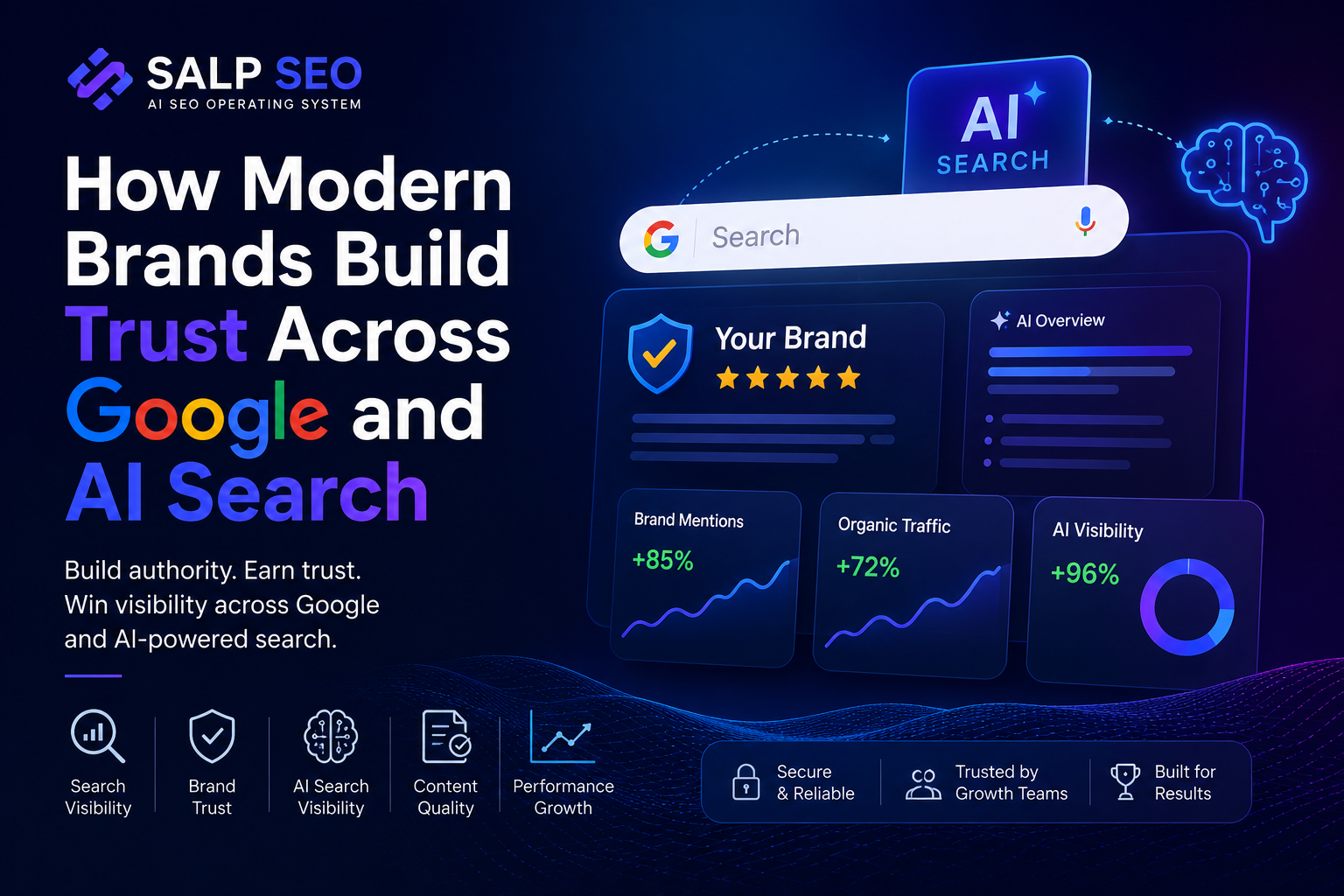
Building trust has become one of the most important ranking factors for modern SEO.
Today’s buyers don’t simply compare products—they compare credibility, transparency, expertise, reviews, documentation, AI visibility, search performance, and how consistently a brand appears across Google and AI-powered search experiences.
SALP SEO is an AI-powered SEO operating system built for brands, agencies, SaaS companies, eCommerce businesses, and growth teams that want to manage every stage of SEO from one platform. Instead of using separate tools for keyword research, competitor monitoring, AI content generation, approvals, publishing, indexing, and optimization, SALP SEO connects these workflows into one approval-driven operating system.
This Buyer Trust Checklist helps organizations evaluate whether their SEO operation is truly prepared to build authority—not just rankings.
Whether you’re launching a new website, managing dozens of client projects, or scaling enterprise SEO, this guide provides a practical framework for building long-term trust across traditional search engines and AI-powered search platforms.
⸻
Why Buyer Trust Matters More Than Ever
Search engines increasingly reward websites that consistently publish useful, accurate, trustworthy content.
At the same time, AI assistants and generative search engines evaluate brands differently than traditional search.
Instead of only matching keywords, they evaluate:
- Brand authority
- Content quality
- Entity consistency
- Product information
- Citations
- Reviews
- Competitor comparisons
- Website structure
- Knowledge signals
- User experience
That means SEO is no longer only about rankings.
It’s about building confidence before someone becomes a customer.
SALP SEO helps organizations manage both traditional SEO and AI Search Visibility from a unified workflow.
Learn more about AI Search Visibility:
https://salpseo.ai/ai-solutions/ai-search-visibility
⸻
What is SALP SEO?
SALP SEO is an AI SEO Operating System designed to manage the complete SEO lifecycle.
Instead of switching between multiple SEO tools, teams can manage:
- Projects
- Competitors
- Keyword Discovery
- Keyword Clustering
- Content Blueprints
- AI Content Generation
- Human Approval Workflows
- Internal Linking
- Schema
- Publishing
- Google Indexing
- AI Search Visibility
- Performance Monitoring
- Optimization Recommendations
Everything works together inside one workflow instead of disconnected applications.
Read more about the platform:
⸻
Who Should Use SALP SEO?
SALP SEO is built for organizations that require structured SEO workflows.
It is particularly suitable for:
SaaS Companies
Manage product-led SEO, landing pages, feature pages, AI visibility, competitor monitoring, and content approvals.
https://salpseo.ai/product/for-saas-marketing
⸻
SEO Agencies
Manage multiple client projects with isolated workspaces, approval workflows, reporting, competitors, publishing, and permissions.
https://salpseo.ai/product/for-agencies
⸻
Enterprise Teams
Support governance, collaboration, security, approvals, audit history, AI workflows, and large-scale content operations.
https://salpseo.ai/product/for-enterprise
⸻
PR & Brand Teams
Monitor brand visibility across Google and AI-generated answers while protecting brand consistency.
https://salpseo.ai/product/for-pr-professionals
⸻
The SALP SEO Buyer Trust Checklist
Think of this checklist as a maturity assessment.
Every completed item increases confidence for both search engines and prospective customers.
⸻
- Project Foundation
Before writing a single article, define:
✅ Business goals
✅ Target audience
✅ Primary products
✅ Services
✅ Geographic markets
✅ Conversion goals
✅ Brand voice
✅ Competitors
SALP SEO organizes every SEO activity around projects instead of disconnected campaigns.
⸻
- Competitor Intelligence
SEO should begin with understanding the market.
Review:
- Competitors
- Keywords
- Content strategy
- Authority
- AI visibility
- Search visibility
- Backlinks
- Content gaps
SALP SEO Competitive Analysis helps identify opportunities before creating new content.
https://salpseo.ai/use-case/competitive-analysis
⸻
- Keyword Discovery
Keyword research should answer:
What problems are customers trying to solve?
Instead of collecting thousands of keywords, identify:
- Commercial keywords
- Informational keywords
- Comparison keywords
- Transactional keywords
- Long-tail opportunities
Group keywords around search intent.
⸻
- Keyword Clustering
Instead of writing one article per keyword, build topic clusters.
Example:
Main Topic
AI SEO
Supporting topics
- AI Search Visibility
- Approval-Gated AI
- Competitor Analysis
- Internal Linking
- Schema
- AI Content
- AI Citations
Clusters build topical authority.
⸻
- Content Blueprints
Every article should begin with a blueprint.
Include:
- Search Intent
- Primary Keyword
- Secondary Keywords
- Audience
- Questions
- CTA
- Internal Links
- Product References
- Schema
- FAQs
A strong blueprint dramatically improves AI-generated content quality.
⸻
- AI Content Generation
AI accelerates production.
However, AI should never publish automatically.
SALP SEO follows an approval-gated workflow where AI drafts are reviewed before publication.
Learn more:
https://salpseo.ai/blog/complete-guide-to-approval-gated-ai-seo-for-b2b-content-teams-1535
⸻
- Human Approval Workflow
Every organization should define:
Who can:
- Create content
- Edit content
- Approve content
- Publish content
Approval gates protect:
- Accuracy
- Compliance
- Brand voice
- Product information
- Technical SEO
⸻
- Internal Linking
Internal links help both users and search engines understand relationships between content.
Good internal linking connects:
Blog →
Guides →
Use Cases →
Products →
Pricing →
Resources
Examples include linking educational articles to:
AI Search Visibility
https://salpseo.ai/ai-solutions/ai-search-visibility
Competitive Analysis
https://salpseo.ai/use-case/competitive-analysis
Resources
Pricing
⸻
- Technical SEO
Before publishing verify:
✅ Canonical URL
✅ Meta Title
✅ Meta Description
✅ H1
✅ Sitemap
✅ Robots.txt
✅ Internal Links
✅ Schema
✅ Image Alt Text
✅ Mobile Performance
✅ Crawlability
Technical SEO should be reviewed before publication.
⸻
- Publishing
Publishing should not be the final step.
Publishing begins the optimization cycle.
SALP SEO supports approval-driven publishing workflows instead of unrestricted automation.
⸻
- Google Indexing
Monitor:
- Indexed pages
- Excluded pages
- Crawl issues
- Canonical conflicts
- Sitemap status
Publishing does not guarantee indexing.
⸻
- AI Search Visibility
Modern SEO extends beyond Google rankings.
Organizations should monitor:
- AI mentions
- Brand citations
- Competitor recommendations
- Product descriptions
- Entity accuracy
SALP SEO AI Search Visibility:
https://salpseo.ai/ai-solutions/ai-search-visibility
⸻
- Performance Monitoring
Measure:
- Organic Traffic
- Impressions
- Clicks
- CTR
- Rankings
- Conversions
- AI Visibility
- Brand Mentions
Optimization decisions should be based on evidence—not assumptions.
⸻
- Continuous Optimization
SEO is never “finished.”
Update:
- Titles
- Meta descriptions
- Internal links
- Content
- FAQs
- Schema
- Product information
Regular optimization maintains authority.
⸻
Common Buyer Trust Mistakes
Many organizations lose trust because they:
❌ Publish AI content without review
❌ Ignore competitor research
❌ Skip keyword clustering
❌ Have inconsistent product messaging
❌ Forget internal links
❌ Never refresh content
❌ Ignore AI visibility
❌ Focus only on rankings
❌ Publish duplicate topics
❌ Fail to monitor indexing
⸻
Best Practices
Successful SEO teams:
✔ Create structured content briefs
✔ Review AI-generated content
✔ Build topic clusters
✔ Monitor competitors
✔ Improve internal linking
✔ Measure conversions
✔ Track AI visibility
✔ Refresh content continuously
✔ Maintain brand consistency
✔ Use approval workflows
⸻
Buyer Trust Scorecard
Ask yourself:
✅ Is every article reviewed?
✅ Does every page have a clear search intent?
✅ Are competitors monitored?
✅ Is technical SEO verified?
✅ Are keyword clusters defined?
✅ Is AI content approved?
✅ Are internal links reviewed?
✅ Is indexing monitored?
✅ Is AI visibility measured?
✅ Is content updated regularly?
The more “Yes” answers, the stronger your long-term SEO foundation.
⸻
Frequently Asked Questions
What makes SALP SEO different?
SALP SEO combines AI-powered SEO, approval workflows, competitor intelligence, keyword management, AI visibility, publishing, indexing, and optimization inside one operating system.
⸻
Is SALP SEO suitable for SaaS?
Yes.
Learn more:
https://salpseo.ai/product/for-saas-marketing
⸻
Can agencies manage multiple clients?
Yes.
Agency workspaces support multiple projects, permissions, approvals, competitors, reporting, and publishing.
https://salpseo.ai/product/for-agencies
⸻
Does SALP SEO monitor AI Search?
Yes.
Monitor AI-generated answers, citations, competitors, and visibility.
https://salpseo.ai/ai-solutions/ai-search-visibility
⸻
Why are approval workflows important?
Approval workflows help prevent inaccurate information, inconsistent branding, technical SEO mistakes, and accidental publication.
⸻
Can SALP SEO help improve Google rankings?
SALP SEO helps teams improve SEO processes through better planning, optimization, approvals, monitoring, and analysis. Rankings depend on many factors, including competition, website authority, content quality, and user intent.
⸻
Final Thoughts
Building buyer trust is no longer just a marketing objective—it’s a search visibility strategy.
Organizations that combine structured workflows, human-reviewed AI, technical SEO, competitor intelligence, keyword clustering, and continuous optimization are better positioned to earn trust across both traditional search engines and AI-powered search experiences.
SALP SEO brings these capabilities together into a single AI SEO operating system designed to help brands scale responsibly while maintaining accuracy, transparency, and measurable performance.
Continue Your SEO Journey
Explore more SALP SEO resources:
- Home: https://salpseo.ai/
- Features: https://salpseo.ai/features
- AI Search Visibility: https://salpseo.ai/ai-solutions/ai-search-visibility
- Competitive Analysis: https://salpseo.ai/use-case/competitive-analysis
- Resources: https://salpseo.ai/resources
- Pricing: https://salpseo.ai/pricing
- SaaS Marketing: https://salpseo.ai/product/for-saas-marketing
- Agencies: https://salpseo.ai/product/for-agencies
- Enterprise: https://salpseo.ai/product/for-enterprise
- PR Professionals: https://salpseo.ai/product/for-pr-professionals
Start building an SEO workflow that combines AI automation, human approvals, technical excellence, and AI search visibility—all from one platform.
Frequently asked questions
What is SALP SEO?
SALP SEO is an AI SEO operating system that helps brands, agencies, SaaS teams, and growth teams monitor and optimize their SEO efforts.
How does approval-gated AI work?
Approval-gated AI generates content and images, which are then reviewed and approved by humans to ensure quality and trust.
Can I use SALP SEO for my SaaS company?
Yes, SALP SEO is designed for SaaS companies and other tech-driven businesses to enhance their SEO efforts.
How do I set up a human approval process?
In the SALP SEO platform, configure the approval workflow to ensure all content is reviewed and approved by humans.
What are the key performance indicators (KPIs) I should track?
Track metrics such as organic traffic, keyword rankings, and conversion rates to measure the success of your SEO efforts.