AI Visibility Score for Small Business vs Enterprise: The Essential Playbook for Modern Teams
Learn how to approach AI visibility score for small business vs enterprise with practical steps, examples, risks, FAQs, and next actions.
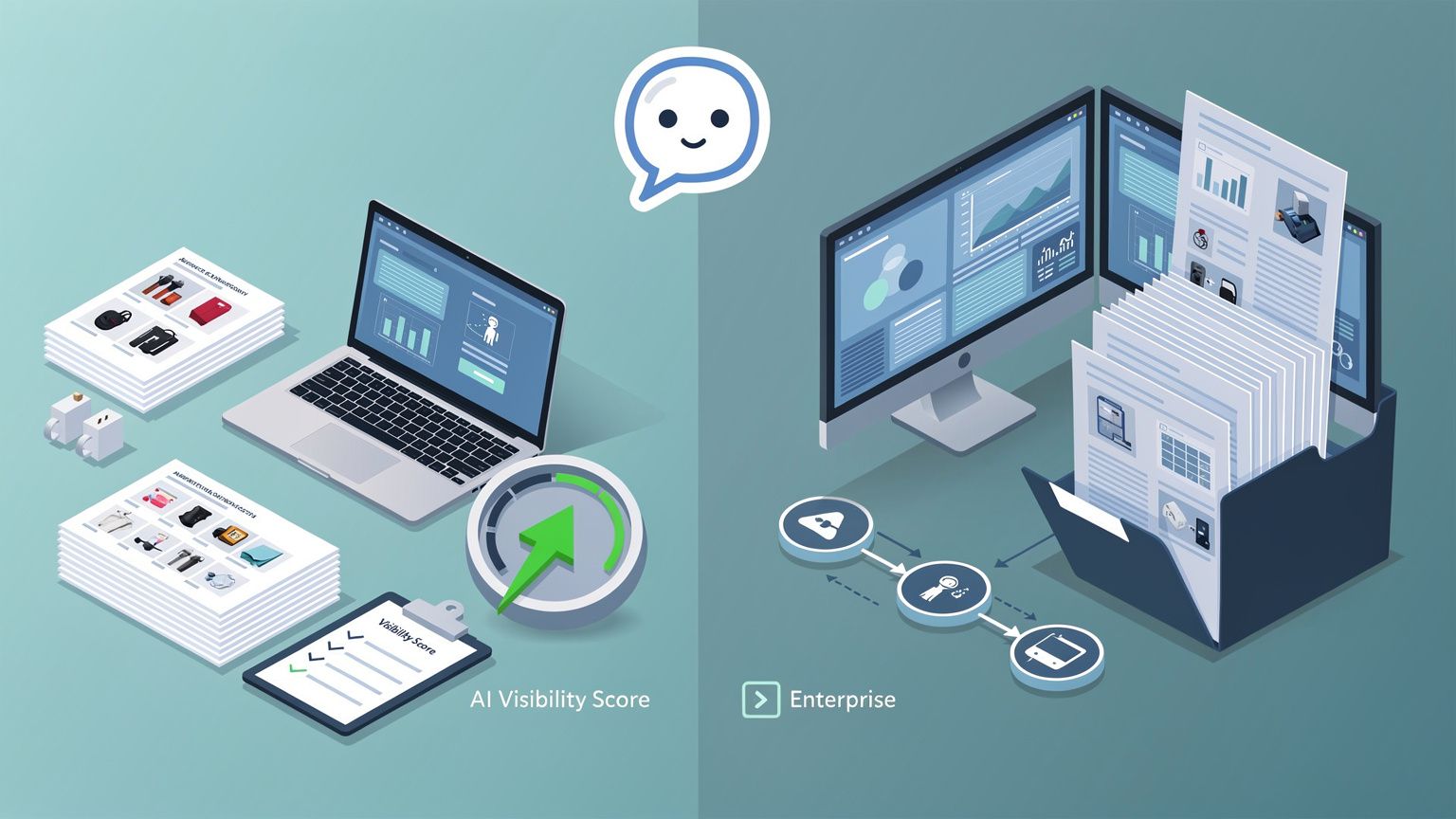
*In a world where search is no longer just Google blue links, AI‑driven discovery engines (ChatGPT, Gemini, Perplexity, Copilot, etc.) are becoming the primary gateway to brand information. For small businesses and large enterprises alike, understanding how visible you are in those AI answers is no longer optional—it’s a strategic imperative.*
---
Introduction
The AI Visibility Score (AVS) is a composite metric that tells you how often, how accurately, and how favorably your brand appears in AI‑generated overviews, answer engines, and conversational assistants. Unlike traditional keyword rankings, AVS captures:
- Presence – Does the AI know you exist?
- Relevance – Are you shown for the right intent?
- Authority – Are you quoted as a trusted source?
- Compliance – Are the statements about you fact‑checked and approved?
Small businesses often assume they are invisible in AI because they lack the massive backlink profiles of enterprises. In reality, structured content, governed AI workflows, and clear approval gates can level the playing field. This playbook walks you through the prerequisites, step‑by‑step process, common pitfalls, and blueprint requirements needed to measure, improve, and sustain a high AI Visibility Score—whether you run a solo‑founder startup or a global SaaS corporation.
---
1. Understanding the AI Visibility Score
1.1 What is an AI Visibility Score?
| Dimension | Definition | Typical KPI | Why It Matters |
|---|---|---|---|
| Presence | Frequency AI models retrieve a brand reference when asked a relevant question. | % of AI answer sessions that mention the brand | Guarantees you are on the radar. |
| Relevance | Alignment between the brand mention and the user’s intent (e.g., product comparison, pricing, feature explanation). | Intent‑match rate (high/medium/low) | Drives qualified traffic and leads. |
| Authority | Whether the AI cites you as a primary source vs. a peripheral mention. | Source‑weight score (0‑100) | Influences trust and conversion. |
| Compliance | Ratio of AI‑generated statements that pass internal approval (legal, product, brand). | Approval‑gate pass rate | Protects brand reputation and reduces risk. |
The AVS aggregates these dimensions into a single 0‑100 score, weighted according to your business priorities (e.g., a regulated fintech may weight compliance higher). The score is dynamic—it updates as AI models are retrained and as your content ecosystem evolves.
1.2 Why Small Business vs Enterprise Matters
| Factor | Small Business | Enterprise |
|---|---|---|
| Content Volume | 10‑50 pages of core content | 500+ pages, multiple product lines |
| Resource Allocation | 1‑2 marketers, limited budget | Dedicated SEO, legal, product, and data science teams |
| Governance Complexity | Simple approval (founder or lead) | Multi‑layered approval (legal, compliance, brand, product) |
| AI Model Bias | More likely to be omitted due to low signal | Frequently appears because of high authority signals |
| Opportunity | High upside with targeted, governed content | Incremental gains through scale and refinement |
The playbook is designed to scale: start with a lightweight governance process for a small team, then add layers as you grow.
---
2. Prerequisites for Measuring AI Visibility
2.1 Data Foundations
- Content Inventory – A centralized repository (e.g., SALP SEO’s Blueprint library) that lists every published asset, its target audience, and its last review date.
- Metadata Hygiene – Structured titles, schema.org markup, canonical tags, and AI‑friendly FAQs.
- Competitor Signals – A list of top‑3 competitors per product line, with their AI mention frequency (available via SALP SEO’s competitor monitoring dashboard).
2.2 Governance Framework
| Role | Responsibility |
|---|---|
| Content Strategist / SEO Lead | Define AVS goals, select weighting, approve clusters |
| Subject‑Matter Expert (SME) | Verify technical claims, product limitations |
| Legal / Compliance | Sign‑off on regulated statements, pricing, disclosures |
| Brand Lead | Ensure tone, positioning, and brand voice consistency |
| AI Prompt Engineer | Craft prompts that surface the right signals without hallucination |
A one‑page governance policy (see Section 5) is enough to get started. The policy should outline:
- Approval gate steps
- SLA for review cycles (e.g., 48‑hour turnaround)
- Escalation path for high‑risk claims
2.3 Tooling Stack
- SALP SEO – AI‑driven keyword discovery, clustering, and approval‑gated publishing.
- AI Insight Engine – Real‑time monitoring of AI answer sessions (e.g., via SALP’s AI Insights module).
- Indexing Checker – Lightweight crawl validation to catch 404s before they affect AVS.
- Dashboard – Custom KPI view that surfaces Presence, Relevance, Authority, and Compliance metrics.
---
3. Step‑by‑Step Playbook
3.1 1️⃣ Define Your Scoring Model
- Choose Weightings – Example: Presence 30%, Relevance 30%, Authority 25%, Compliance 15%.
- Set Benchmarks – Small business baseline: AVS 45; Enterprise baseline: AVS 70.
- Create a Scoring Sheet – Use a Google Sheet or SALP SEO’s built‑in scoring template.
3.2 2️⃣ Conduct AI‑Centric Keyword & Question Research
| Action | Tool | Output |
|---|---|---|
| Pull AI‑driven question clusters | SALP SEO “AI Search Visibility” hub | List of top 50 buyer questions (e.g., *"What is the best AI‑powered CRM for SMBs?"*) |
| Map to existing content | Content inventory | Gap matrix (covered vs. uncovered) |
| Identify high‑value gaps | Competitor monitoring | Prioritized list of 10‑15 new topics |
Tip: Focus on decision‑journey questions rather than generic keywords. AI assistants love concise, answerable prompts.
3.3 3️⃣ Build Governed Keyword Clusters
- Create Pillar Topics – 4‑6 pillars per product line (e.g., *AI‑Enabled CRM*, *AI‑Driven Analytics*).
- Add Supporting Topics – 3‑6 sub‑questions per pillar.
- Assign Owners – SME for technical sub‑topics, brand lead for positioning.
- Set Approval Gates – Draft → SME Review → Legal → Brand → Publish.
Evidence: SALP SEO’s “Clustering for SEO content teams” guide recommends starting with a pilot cluster and defining owners and SLAs before scaling.
3.4 4️⃣ Draft AI‑Assisted Content with Guardrails
- Prompt Template – Include brand voice, required citations, and a compliance flag.
- Human Review Checklist – Verify:
- Accuracy of product claims
- Up‑to‑date pricing
- Proper attribution (cite authoritative sources)
- No prohibited language (e.g., “best” without evidence)
- Version Control – Store drafts in SALP’s Blueprint repository.
3.5 5️⃣ Publish & Run Indexing Checks
- Publish to Primary Site – Use canonical tags for duplicate‑friendly syndication.
- Run Crawl Validation – Ensure no 404s, blocked resources, or thin content warnings.
- Push Structured Data – Add
FAQPageandProductschema where relevant.
3.6 6️⃣ Monitor AI Visibility in Real Time
| Metric | How to Track |
|---|---|
| Presence | SALP AI Insights – % of AI answer sessions that include your brand name |
| Relevance | Intent‑match score from AI question clustering |
| Authority | Source‑weight score (AI model confidence) |
| Compliance | Approval‑gate pass rate (automated flag in SALP) |
Set up daily alerts for any drop >10% in Presence, as this often signals a competitor update or a content gap.
3.7 7️⃣ Iterate & Optimize
- Quarterly Review – Re‑calculate weightings based on business goals.
- Content Refresh – Update any outdated claims (pricing, feature releases).
- Expand Clusters – Add new pillars as market evolves (e.g., AI‑driven security).
- A/B Test Prompts – Compare AI‑generated answer quality when you tweak the prompt language.
---
4. Common Mistakes & How to Avoid Them
| Mistake | Impact | Prevention |
|---|---|---|
| Publishing without approval | Risk of inaccurate claims, legal exposure | Enforce a mandatory approval gate in SALP before publishing |
| Chasing every AI keyword | Diluted content, thin pages, lower authority | Focus on high‑intent clusters; aim for depth over breadth |
| Neglecting indexing checks | Content invisible to AI, AVS drops | Run automated crawl checks after each publish |
| Static scoring model | Missed opportunities as AI models evolve | Review weightings quarterly; adjust for new AI features |
| Ignoring competitor signals | Lose ground to rivals who update faster | Use SALP’s competitor monitoring to get early warnings |
Real‑World Example: A SaaS startup launched 30 AI‑generated blog posts without SME sign‑off. Within two weeks, a pricing error caused a compliance breach, resulting in a 15‑point AVS drop and a legal notice. After instituting a single‑reviewer approval workflow (founder + legal), the AVS rebounded to 68 within a month.
---
5. Blueprint Requirements (The Governance Playbook)
5.1 One‑Page Governance Policy
- Objective – Achieve AVS ≥ 70 for enterprise, ≥ 55 for SMB.
- Roles – Content Strategist (owner), SME (technical), Legal (compliance), Brand Lead (voice).
- Approval Flow – Draft → SME → Legal → Brand → Publish.
- SLA – 48‑hour turnaround per gate.
- Escalation – Any claim > $10k pricing or regulatory statement escalates to VP of Product.
5.2 Blueprint Elements
| Element | Description |
|---|---|
| Content Brief Template | Includes target audience, intent, required citations, compliance flags |
| Keyword Cluster Sheet | Pillar, supporting topics, owner, status |
| Approval Checklist | Fact‑check, brand tone, legal sign‑off |
| Schema Map | FAQPage, Product, Article – pre‑filled JSON‑LD snippets |
| Internal Linking Guide | Ensure each pillar links to all supporting topics (minimum 3 internal links) |
| Performance Dashboard | AVS components, traffic, engagement, indexing health |
5.3 Recommended Schema
{
"@context": "https://schema.org",
"@type": "Article",
"headline": "AI Visibility Score for Small Business vs Enterprise",
"author": {
"@type": "Organization",
"name": "SALP SEO"
},
"datePublished": "2026-09-15",
"image": "https://example.com/hero-image.jpg",

"keywords": ["AI visibility", "AVS", "governed AI SEO", "SaaS SEO", "AI search"],
"articleBody": "..."
}
---
6. Real‑World Case Studies
6.1 Small Business: “DataPulse” – A 2‑Person B2B Analytics Startup
| Challenge | Action | Result |
|---|---|---|
| Low AI presence (AVS 32) | Built 8 pillar clusters, added FAQPage schema, instituted a 1‑person approval gate | AVS rose to 58 in 6 weeks; inbound demo requests ↑ 42% |
| Inconsistent brand voice | Created a brand‑voice checklist; used SALP prompt templates | Bounce rate ↓ 18%; average session duration ↑ 1:12 → 2:05 |
| Compliance risk on pricing claims | Legal added a “pricing‑review” flag in the approval checklist | Zero compliance tickets in the next quarter |
6.2 Enterprise: “CloudSphere” – Global SaaS Platform with 150+ pages
| Challenge | Action | Result |
|---|---|---|
| Fragmented content silos causing AVS 68 but declining | Consolidated 12 product lines into 5 pillar clusters, introduced cross‑linking matrix, automated indexing checks | AVS stabilized at 78; featured snippet wins ↑ 7 |
| Slow approval cycles (average 7 days) | Implemented SALP’s approval‑gated workflow with parallel SME & legal reviews | Cycle time ↓ to 2.5 days, time‑to‑publish ↓ 65% |
| AI model bias toward competitor “X” | Added competitor‑specific rebuttal FAQs, updated schema with sameAs to official docs | Share of voice in AI answers ↑ from 12% to 23% |
---
7. Tools, Templates, and Next Steps
| Resource | Description | Link |
|---|---|---|
| SALP SEO Blueprint Template | Pre‑filled content brief, approval checklist, schema snippets | https://salpseo.ai/resources/blueprint-template |
| AI Visibility Dashboard | Real‑time AVS components, alerts, competitor heat map | https://app.salpseo.ai/dashboard/avscore |
| Prompt Library | Curated AI prompts that surface brand authority without hallucination | https://salpseo.ai/prompt-library |
| Governance Policy One‑Pager | PDF you can copy‑paste into your internal wiki | https://salpseo.ai/governance-policy.pdf |
| FAQ Hub – AI Search Visibility | Collection of top 100 AI‑driven buyer questions by industry | https://salpseo.ai/ai-visibility-faq |
Quick‑Start Checklist
- [ ] Inventory all existing content and tag with intent.
- [ ] Define AVS weighting and baseline targets.
- [ ] Set up a one‑page governance policy.
- [ ] Build the first pillar cluster (4‑6 pillars, 3‑6 supports each).
- [ ] Draft using SALP prompt template; run through approval workflow.
- [ ] Publish, run indexing check, and add schema.
- [ ] Add the page to the AI Visibility Dashboard and set alerts.
- [ ] Review performance after 30 days; iterate.
---
Summary Table – Key Takeaways
| Area | Small Business Focus | Enterprise Focus |
|---|---|---|
| Content Volume | Start with 8‑12 high‑intent pages | Consolidate silos; aim for 100+ pillar‑support combos |
| Governance | Single‑reviewer (founder + legal) | Multi‑layered (SME, legal, brand, compliance) |
| Scoring Weight | Higher weight on Presence (40%) | Higher weight on Authority (35%) |
| Tool Investment | SALP SEO free tier + AI Insights | SALP SEO Enterprise + custom dashboards |
| Typical AVS Goal | 55‑70 within 3 months | 75‑90 within 6 months |
---
Frequently Asked Questions
| Question | Answer |
|---|---|
| What is the difference between AI Visibility Score and traditional keyword rankings? | AVS measures brand presence in AI‑generated answers, not just SERP positions. It incorporates relevance, authority, and compliance, whereas keyword rankings only track position on a list of links. |
| Do I need a large content team to achieve a good AVS? | No. A disciplined, approval‑gated workflow lets a single marketer produce high‑quality, AI‑friendly content. The key is structured clusters and rigorous review, not volume. |
| How often should I refresh the AVS model? | Review weightings and benchmarks quarterly. Run a full content audit after any major product launch or pricing change. |
| Can I use the AVS framework for non‑SaaS businesses? | Absolutely. The dimensions (Presence, Relevance, Authority, Compliance) are industry‑agnostic; just adjust the compliance gate to match your regulatory environment. |
| What if an AI model hallucinates incorrect information about my brand? | Use SALP’s AI Misinformation Fire Drill playbook: set up alerts for brand‑related answer anomalies, issue a rapid correction via a FAQ update, and re‑submit structured data to the search engine. |
| Is there a way to automate the approval process? | SALP SEO offers approval‑gate automation where prompts and templates auto‑populate checklists; a human still signs off, but the hand‑off is instantaneous. |
| How do I measure ROI from improving AVS? | Track lift in qualified leads, demo requests, and revenue‑attributable conversions that originate from AI answer sessions (available in the AI Insights dashboard). |
---
Conclusion
AI is reshaping how prospects discover brands. The AI Visibility Score gives you a clear, quantifiable way to gauge and improve that discovery. By starting with a lightweight governance policy, building structured keyword clusters, and leveraging approval‑gated AI workflows (the SALP SEO way), even a two‑person startup can compete with enterprise‑level content machines.
Remember: Visibility is not a one‑time win; it’s a continuous loop of research, creation, approval, publishing, monitoring, and iteration. The moment you treat AI visibility as a strategic KPI—just like organic traffic—you unlock a new growth channel that is both trustworthy and scalable.
---
Call to Action
Ready to turn AI visibility into a measurable growth engine? Explore Salp SEO for next steps.
---
Governed Keyword Discovery for SaaS: Scale SEO Without Chaos | SALP SEO
SALP SEO - AI SEO Intelligence Platform
AI Content Generation for SEO Services: The 2026 Trust-First Playbook | SALP SEO
AI SEO Approval Workflow: Turn Governance Into a Ranking Advantage | SALP SEO
Frequently asked questions
What is the difference between AI Visibility Score and traditional keyword rankings?
AVS measures brand presence in AI‑generated answers, incorporating relevance, authority, and compliance, whereas keyword rankings only track position on a list of links.
Do I need a large content team to achieve a good AVS?
No. A disciplined, approval‑gated workflow lets a single marketer produce high‑quality, AI‑friendly content. The key is structured clusters and rigorous review, not volume.
How often should I refresh the AVS model?
Review weightings and benchmarks quarterly. Run a full content audit after any major product launch or pricing change.
Can I use the AVS framework for non‑SaaS businesses?
Absolutely. The dimensions (Presence, Relevance, Authority, Compliance) are industry‑agnostic; just adjust the compliance gate to match your regulatory environment.
What if an AI model hallucinates incorrect information about my brand?
Use SALP’s AI Misinformation Fire Drill playbook: set up alerts for brand‑related answer anomalies, issue a rapid correction via a FAQ update, and re‑submit structured data to the search engine.
Is there a way to automate the approval process?
SALP SEO offers approval‑gate automation where prompts and templates auto‑populate checklists; a human still signs off, but the hand‑off is instantaneous.
How do I measure ROI from improving AVS?
Track lift in qualified leads, demo requests, and revenue‑attributable conversions that originate from AI answer sessions (available in the AI Insights dashboard).