Turn SaaS Content Into AI Citations With an Automated Knowledge Graph
Learn how to automate a knowledge graph for AI visibility in SaaS, with practical steps for creating citation-ready content, governing entity data, and monitoring results
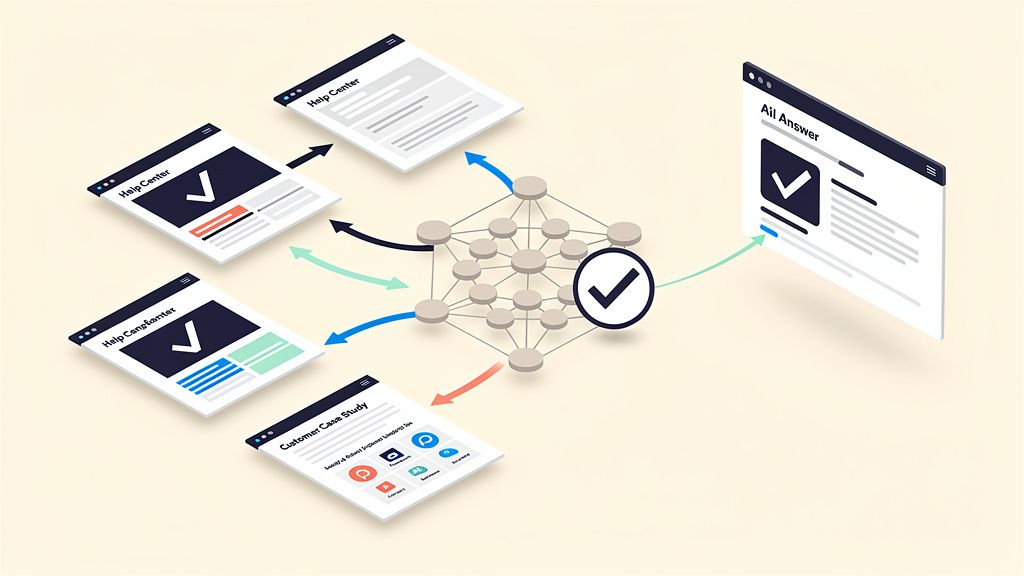
AI search systems do not evaluate SaaS content exactly like a traditional search engine results page. They increasingly assemble answers from entities, relationships, trusted sources, product facts, customer evidence, and topical context. If your product messaging is fragmented across blog posts, feature pages, help docs, comparison pages, press mentions, and social profiles, it becomes harder for AI systems to identify what your company does, who it serves, and when it should be mentioned.
An automated knowledge graph gives your SaaS team a practical way to organize this information. It turns scattered marketing and product information into an approved, connected source of truth that can guide content creation, updates, internal linking, schema decisions, and AI visibility monitoring.
The objective is not to manipulate AI answers or guarantee a mention in a particular model. The goal is to make the evidence about your company clearer, more consistent, easier to verify, and more useful to the people researching a problem. When your web presence presents stable entities, specific relationships, and credible supporting material, your content is better positioned to be understood, surfaced, and cited where relevant.
For SaaS teams, the strongest approach is governance-first: use automation to collect, connect, and recommend, while keeping humans responsible for product truth, brand language, compliance, and publication decisions.
What an AI visibility knowledge graph does for SaaS
A knowledge graph is a structured map of important things and their relationships. In SaaS marketing, those “things” are usually not abstract technical concepts. They are the real entities that shape buyer understanding:
- Your company and brand
- Products, modules, and features
- Use cases and jobs to be done
- Customer segments and industries
- Integrations and technology partners
- Competitors and alternatives
- Product terminology and approved claims
- Experts, authors, and subject-matter reviewers
- Supporting resources such as help articles, case studies, templates, and comparison pages
The relationships matter just as much as the entities. For example:
- A product serves a specific audience.
- A feature solves a defined workflow problem.
- An integration connects with another platform.
- A case study supports a claimed outcome.
- A comparison page explains differences from an alternative.
- A guide answers a question associated with a use case.
This structure helps a content team move beyond a keyword list. Instead of asking only, “What page should we write for this query?” your team can ask:
- Which entity is the user trying to understand?
- What relationship or decision is behind the question?
- What evidence supports our answer?
- Which existing page should be updated, linked, or consolidated?
- Does the proposed content repeat, contradict, or strengthen our existing knowledge?
Why this matters for AI citations
AI systems often synthesize information from multiple sources. A generic article with a broad keyword may be relevant, but it may not provide enough specific, consistent evidence to be useful in an answer. Citation-ready SaaS content tends to have several qualities:
- It clearly defines concepts and product capabilities.
- It uses consistent product and feature naming.
- It answers a focused question rather than hiding the answer in promotional language.
- It connects statements to credible first-party or third-party evidence.
- It is updated when product capabilities, pricing, policies, or integrations change.
- It is accessible to crawlers and connected through sensible internal links.
An automated knowledge graph supports these qualities by creating a controlled content foundation. It can identify missing relationships, flag conflicting terminology, show which claims lack evidence, and recommend content opportunities that fit a coherent topical system.
Traditional content operations versus graph-led operations
| Area | Traditional content workflow | Graph-led, approval-gated workflow |
|---|---|---|
| Planning | Starts with isolated keywords | Starts with entities, intent, relationships, and evidence |
| Product facts | Often live in scattered documents | Managed as approved, reusable source material |
| Content briefs | Written from scratch each time | Generated from entity and relationship context |
| Internal links | Added manually or inconsistently | Recommended from meaningful topic connections |
| Content refreshes | Triggered reactively | Triggered by product, market, entity, or performance changes |
| AI visibility | Difficult to connect to content operations | Monitored alongside citations, mentions, competitors, and approved updates |
| Governance | Review happens late, if at all | Approval gates are built into the workflow |
A graph does not replace editorial judgment. It gives editorial judgment better inputs and a more reliable operating model.
Prerequisites: build the foundation before automating
Before connecting tools or generating pages at scale, establish a small but dependable source of truth. The biggest mistake teams make is automating inconsistency. If the inputs are unclear, automation simply distributes unclear material faster.
Define your core entity model
Start with a lightweight model. You do not need to map every noun on your website. Begin with the entities that influence customer decisions and content production.
For most SaaS companies, the initial entity groups are:
- Brand entities: company name, product names, approved descriptions, founder or expert profiles, brand categories.
- Product entities: modules, features, integrations, security capabilities, plans, and implementation services.
- Audience entities: roles, company sizes, industries, maturity levels, and buying committees.
- Problem entities: pain points, workflows, requirements, risks, and desired outcomes.
- Content entities: guides, feature pages, documentation, case studies, templates, webinars, comparison pages, and glossary entries.
- Market entities: competitors, categories, adjacent tools, analysts, communities, and publications.
Keep the first version focused. A B2B SaaS platform for finance teams might begin with 30 to 50 high-value entities rather than attempting to catalogue thousands of concepts.
Create an approved claims library
Every SaaS organization has statements that appear repeatedly across its site. These can include product descriptions, security language, integration details, customer outcomes, and category positioning. Put those statements in a governed claims library.
For each claim, record:
- The approved wording
- The owner responsible for accuracy
- Supporting evidence or destination URL
- Allowed contexts
- Restricted or prohibited wording
- Last review date
- Review trigger, such as a release, policy update, or legal change
For example, instead of allowing writers to improvise around a capability, define a clear statement:
“The platform centralizes AI visibility monitoring, SEO research, content approvals, and growth reporting in one operating workflow.”
The content team can adapt the statement for readability, but it should not imply unsupported guarantees such as automatic rankings, guaranteed citations, or full autonomy without review.
Set governance roles and approval gates
Knowledge graph automation is most effective when it has explicit ownership. Assign roles before publishing workflows begin.
| Role | Primary responsibility | Typical approval scope |
|---|---|---|
| SEO lead | Topic strategy, query intent, content ecosystem | Keyword clusters, briefs, optimization actions |
| Content strategist | Editorial structure and usefulness | Outlines, drafts, internal-link plans |
| Product SME | Product accuracy and roadmap sensitivity | Features, workflows, integrations, implementation claims |
| Brand reviewer | Voice, terminology, positioning | Messaging consistency and naming |
| Legal or compliance reviewer | Regulated, contractual, and sensitive claims | Security, privacy, financial, healthcare, or legal content |
| Publisher | Technical release quality | Metadata, schema, links, indexing readiness |
Not every article needs every reviewer. A glossary update may only need an SEO and content review. A security guide or enterprise comparison page may require product, legal, and brand approval.
The important point is to define the gate before the content is generated. This avoids a common failure mode: an AI draft is already in the CMS, deadlines are tight, and reviewers feel pressured to approve material they have not had time to validate.
Establish technical and measurement readiness
Your graph will only support visibility if the resulting content can be discovered and evaluated. Confirm that your operating checklist includes:
- Crawlable, indexable pages where appropriate
- Canonical tags and duplicate-content controls
- XML sitemap inclusion for priority content
- Logical internal links from relevant hub and supporting pages
- Clear author, organization, and article details where relevant
- Structured data chosen for user-facing accuracy, not decoration
- Search performance monitoring for impressions, clicks, CTR, and average position
- AI visibility, brand mention, competitor, sentiment, and citation monitoring
A page can be live and indexed yet still earn no impressions. Treat this as an operational signal, not a reason to generate more pages immediately. Recheck query targeting, content uniqueness, internal linking, sitemap discoverability, and whether the page genuinely satisfies a searchable need.
Step-by-step process to automate your SaaS knowledge graph
The most reliable process is incremental. Start with one use case cluster, prove the workflow, and then expand across the site.
1. Select a pilot cluster with commercial and informational value
Choose a topic that has enough depth to support multiple connected pages. Good pilot clusters usually connect a buyer problem with your product’s genuine expertise.
Examples include:
- AI visibility monitoring for SaaS brands
- Approval-gated AI SEO workflows
- SaaS onboarding content operations
- Competitor monitoring for B2B growth teams
- Brand entity consistency across AI search and Google
Avoid starting with the broadest category term on your site. A narrowly defined pilot gives you a clearer view of what works and reduces the risk of creating a large volume of weak, overlapping pages.
For a platform such as SALP SEO, a useful cluster could connect the entities AI visibility, content approvals, competitor signals, indexing checks, SaaS teams, and growth reporting. Each article should clarify one relationship within that system.
2. Inventory and normalize existing content
Export your important URLs and classify them. Include product pages, blog posts, documentation, case studies, category pages, and high-performing legacy content.
For each URL, record:
- Primary topic and intent
- Main entities mentioned
- Product capabilities referenced
- Audience segment
- Supporting evidence
- Current internal links
- Status: keep, refresh, merge, redirect, retire, or expand
- Relevant performance signals
Then normalize naming. If one page calls a capability “AI search monitoring,” another calls it “LLM visibility tracking,” and a third calls it “citation tracking,” decide which phrase is the primary entity label and which phrases are supported aliases.
This does not mean every phrase must be replaced. It means the relationship is explicit: they may be related concepts, but they are not automatically identical. Consistency helps readers, writers, sales teams, and search systems understand the product language.
3. Map relationships and evidence
Next, build a relationship table. A spreadsheet is enough for the initial version, although a dedicated system becomes more useful as your content operation expands.
| Source entity | Relationship | Target entity | Evidence needed |
|---|---|---|---|
| AI visibility monitoring | Helps identify | Brand mentions | Monitoring workflow or product documentation |
| Content approval gates | Reduce risk in | AI-assisted publishing | Governance policy and reviewer process |
| Competitor monitoring | Informs | Content priorities | Search and market intelligence data |
| Indexing checks | Support | Discoverability diagnosis | Technical SEO review process |
| SaaS onboarding content | Serves | New users and evaluators | Onboarding goals, guides, or product workflow |
The evidence column is essential. It prevents the graph from becoming a collection of assumptions. When a relationship does not have proof, label it as a hypothesis and assign someone to validate it before turning it into published copy.
4. Turn graph gaps into editorial blueprints
Once you can see entities and relationships, content gaps become easier to prioritize. A gap may be:
- A high-value concept with no clear definition page
- A product-feature relationship that lacks an explanation
- A customer question answered only in sales calls
- A comparison relationship with no factual, balanced content
- A use case that appears in product messaging but not in educational content
- A supporting resource that is orphaned from its relevant hub
Create a blueprint for every priority page. The blueprint should include more than a keyword and an outline. It should define the content’s role in the graph.
A strong blueprint contains:
- Primary audience and decision stage
- Search intent and the specific question being answered
- Primary entity and related entities
- Claims that may be used
- Evidence sources and reviewer requirements
- Required internal links in and out
- Potential schema approach, if it accurately reflects the page
- Update triggers
- Success signals, such as indexed status, impressions, engagement, qualified conversions, or AI mentions
This gives writers and AI systems a disciplined brief. They can create useful variation without drifting away from approved knowledge.
5. Generate content with bounded prompts, not open-ended prompts
AI writing can accelerate drafting, but open-ended prompts often create vague claims, generic sections, and unnecessary repetition. Use prompts that include graph context and constraints.
For example, a bounded generation prompt should specify:
- The primary topic and reader question
- Approved product terminology
- Entity relationships that must be explained
- Claims that require source support
- Claims that must not be made
- Required examples, caveats, and internal-link opportunities
- Desired tone and reading level
- Reviewer names or approval categories
A practical instruction might be: explain how approval-gated AI SEO supports scalable content operations, distinguish monitoring from guaranteed citation outcomes, and include operational steps for indexing checks and performance review.
This produces a more credible article than asking an AI tool to “write a comprehensive post about AI SEO.”
6. Apply approval gates before publishing
Use a structured review queue. The objective is speed with accountability, not slow bureaucracy.
A typical sequence is:
- Automated validation: check headings, metadata, link formatting, duplicate phrasing, broken URLs, prohibited claims, and basic readability.
- SEO review: validate intent, topic coverage, internal linking, page overlap, and search opportunity.
- SME review: verify product facts, workflow descriptions, integration details, and implementation guidance.
- Brand and compliance review: confirm tone, terminology, substantiation, and required disclosures.
- Publication review: check image relevance, accessibility details, schema accuracy, canonicalization, and indexability.
Approval gates are especially valuable for pages that may influence enterprise buying decisions, regulatory trust, product expectations, or company reputation.
7. Publish as a connected content system
A useful page should not be isolated. Link it to the hub page that explains the broader category and to supporting pages that help readers take the next step.
For example, an article about automating brand entity consistency could link to:
- A guide on governed AI keyword discovery
- A page describing approval-gated AI SEO workflows
- A resource on AI search competitor monitoring
- A practical indexing-check checklist
- A product page describing the platform’s monitoring and reporting capabilities
Use descriptive anchor text. Avoid forcing links just to increase link count. Each link should help the reader progress from a question to an explanation, process, proof point, or action.
8. Monitor results, update the graph, and refresh deliberately
The graph becomes valuable when it remains current. Establish a review cadence that combines technical, editorial, and market signals.
Monitor:
- Indexing status and crawl issues
- Impressions, clicks, CTR, and average position
- Brand mentions and AI visibility observations
- Competitor narratives and category shifts
- Content approval cycle time
- Pages that need repeated factual corrections
- Content that is attracting the wrong audience or intent
- Changes to product positioning, capabilities, integrations, or policies
When a product release changes a feature, update the central entity record first. Then use the graph to identify every page, comparison, guide, and internal link affected by that change. This is much safer than relying on memory or ad hoc CMS searches.
Common mistakes that weaken AI citation readiness
Automation can make content teams faster, but it can also amplify structural problems. Watch for these mistakes early.
Mistake 1: Treating a knowledge graph as a keyword dump
Keywords are useful inputs, but they are not a graph. A graph should clarify real-world concepts and meaningful relationships. If every node is simply a long-tail query, your team may produce thin pages that overlap heavily and do little to establish authority.
Better approach: Start with the buyer’s problem, the product entity, the use case, and the proof required. Add keywords as language people use to find those concepts.
Mistake 2: Publishing inconsistent product language
Inconsistent terms make content harder to maintain and can confuse readers. This is especially common when product marketing, demand generation, sales, support, and external agencies all create content independently.
Better approach: Maintain approved entity names, aliases, definitions, and prohibited language. Give writers access to the same library used by product and brand teams.
Mistake 3: Generating claims without evidence
AI-generated content can sound confident even when the underlying statement is unsupported. This is risky for security, compliance, performance, integrations, customer outcomes, and competitor comparisons.
Better approach: Require every high-stakes claim to point to an approved source, product owner, customer evidence, or clear qualification. If evidence is unavailable, reframe the copy as a general consideration rather than a product promise.
Mistake 4: Ignoring pages that are indexed but invisible
A live page with no impressions is not automatically a technical failure. It may be poorly targeted, internally isolated, duplicative, too generic, or mismatched with user intent.
Better approach: Diagnose before rewriting. Review the target query, title and headings, uniqueness, links from relevant pages, sitemap status, topical context, and whether the page delivers a clear answer quickly.
Mistake 5: Creating content without a refresh path
SaaS content becomes stale quickly when product capabilities, integrations, pricing models, terminology, or market alternatives change.
Better approach: Add an owner and update trigger to each high-value node. A new release, a discontinued integration, a major competitor change, or recurring sales objections should trigger review of related content.
Mistake 6: Measuring only rankings
Rankings are useful, but they are not the whole operating picture. A graph-led workflow should also measure whether the content is indexed, understood, connected, approved efficiently, and producing the right business conversations.
Better approach: Use a lightweight dashboard that combines search performance, indexing checks, content health, AI visibility signals, approvals, and optimization recommendations.
A practical operating model for small teams, agencies, and enterprise SaaS
The same strategic principles apply across company sizes, but implementation should match your complexity.
Small SaaS teams
A small team does not need a dedicated graph engineering project. Start with a shared repository containing your top entities, claims, audience segments, and content blueprints.
Prioritize:
- One pilot topic cluster
- A single owner for product facts
- A simple approval checklist
- Monthly review of priority pages
- A controlled list of 10 to 20 core internal links
The key benefit is focus. Small teams can avoid publishing large volumes of loosely connected content and instead build a compact, useful knowledge system.
Agencies managing multiple clients
Agencies need strong boundaries. Each client should have separate entity libraries, style rules, approved claims, competitors, and approval paths. Cross-client reuse of generic process templates is useful; cross-client reuse of factual claims is not.
Prioritize:
- Client-specific workspaces and roles
- Clear review SLAs
- A documented source for every substantive claim
- Change logs for client approvals
- Consistent reporting that explains both progress and risks
For agencies, the graph is also a quality-control asset. It helps strategists explain why a content recommendation matters, how it relates to the client’s existing assets, and which reviewer must validate it.
Enterprise SaaS organizations
Enterprise teams often have the opposite problem: plenty of information, but too many disconnected systems and stakeholders. Their graphs need stronger governance, but they should still begin with a high-value domain rather than attempting a company-wide ontology immediately.
Prioritize:
- Formal taxonomy ownership
- Product and legal approval workflows
- Region- or industry-specific claim controls
- Audit trails for sensitive pages
- Integration with product documentation and content systems
- Dashboards that show portfolio-level risk and opportunity
The goal is to centralize intelligence without slowing every team down. Automation should direct the right evidence to the right reviewer at the right time.
Key takeaways and next actions
| Priority | What to do | Why it matters |
|---|---|---|
| Start small | Build one pilot content cluster | Reduces risk and creates a repeatable model |
| Define entities | Standardize products, audiences, use cases, and claims | Improves consistency across content and teams |
| Connect evidence | Map each major claim to a source or reviewer | Prevents unsupported AI-generated statements |
| Use approval gates | Review high-stakes content before publishing | Protects brand integrity, accuracy, and compliance |
| Publish connected pages | Build useful internal links around real relationships | Helps users and crawlers understand the topic system |
| Monitor continuously | Track indexing, search performance, AI visibility, and competitors | Turns content operations into an evidence-led feedback loop |
| Refresh from the source of truth | Update entity records before editing pages | Makes product and messaging changes easier to manage |
An automated knowledge graph is not a one-time SEO deliverable. It is a content operating system that gets better as your team adds validated facts, finds gaps, updates relationships, and learns from performance.
The practical path is straightforward: choose one buyer-relevant cluster, establish a shared claims library, map the important relationships, generate bounded content briefs, require human approval where it matters, and measure what happens after publication. Over time, your SaaS site becomes more coherent for readers, your internal teams, traditional search, and AI-powered discovery.
SALP SEO supports this kind of governed workflow by bringing AI visibility monitoring, competitor research, keyword discovery, content approvals, publishing readiness, indexing checks, performance tracking, and optimization recommendations into one operating system.
Frequently asked questions
Can an automated knowledge graph guarantee that my SaaS will be cited by AI search?
No. No responsible process can guarantee that an AI model will cite a particular company or page. A knowledge graph improves the clarity, consistency, evidence quality, and maintainability of your content. Those factors can make your information more useful and easier to validate, but citation decisions remain dependent on the AI system, its sources, the user’s query, and the broader information landscape.
Do we need a graph database to start?
No. Many SaaS teams should begin with a governed spreadsheet, content repository, or workflow platform. The important early work is defining entities, relationships, claims, owners, and approval rules. Use more advanced graph technology when the scale and complexity justify it.
What content should be added to the graph first?
Start with high-impact assets: core product pages, feature pages, key use-case pages, documentation, comparison pages, customer stories, category guides, and the articles that already earn meaningful impressions or conversions. These assets are most likely to influence product understanding and reveal valuable content gaps.
How often should the knowledge graph be updated?
Update it whenever a material product, messaging, policy, integration, or market change occurs. In addition, conduct a scheduled review of priority clusters at least quarterly. High-stakes topics, fast-changing product areas, and active comparison pages may need more frequent review.
How does this help with brand entity consistency?
The graph creates a controlled reference for official names, aliases, product relationships, approved definitions, and supporting evidence. Writers, agencies, and AI tools can work from the same source rather than inventing variations. This reduces conflicting language across your website and supports a more understandable brand presence.
What should human reviewers check before publication?
Reviewers should validate product accuracy, evidence quality, search intent, brand terminology, compliance risks, internal links, metadata, and technical publication readiness. For sensitive content, confirm that the page does not imply guarantees, disclose information that should remain confidential, or make unsupported comparisons.
Is this useful for agencies as well as in-house SaaS teams?
Yes. Agencies can use a client-specific graph to organize brand facts, content opportunities, approved claims, competitors, reviewer roles, and reporting. This creates clearer handoffs, fewer approval surprises, and more defensible recommendations for each client.
Conclusion
To turn SaaS content into stronger candidates for AI citations, focus less on generating more pages and more on making your existing knowledge explicit, connected, current, and governed. An automated knowledge graph creates the structure. Approval gates protect the truth. Monitoring shows where the market, competitors, and content performance are changing.
Build the system around real buyer questions and verified product knowledge, then let automation handle the repetitive work of discovery, mapping, briefing, checks, and reporting. Your team remains responsible for the judgment that matters most: deciding what is accurate, useful, and worthy of publication.
Explore Salp SEO for next steps.
SALP SEO - AI SEO Intelligence Platform
Governed AI Keyword Discovery: Turning Compliance into Growth Signals | SALP SEO
Frequently asked questions
Can an automated knowledge graph guarantee AI citations?
No. It cannot guarantee a citation, but it can improve the clarity, consistency, evidence quality, and maintainability of information that AI systems and users may rely on.
Do SaaS teams need a graph database to begin?
No. Begin with a governed repository or spreadsheet that documents entities, relationships, claims, evidence, owners, and approval requirements.
Which SaaS pages should be mapped first?
Start with core product, feature, use-case, documentation, comparison, case-study, and high-performing content pages.
How often should a knowledge graph be refreshed?
Update it when product, policy, integration, or positioning changes occur, and review high-priority content clusters on a regular quarterly cadence.
How do approval gates improve AI SEO content?
They ensure AI-assisted drafts are reviewed for product accuracy, substantiation, compliance, brand consistency, technical readiness, and search intent before publishing.
What should teams measure after publishing?
Track indexing status, impressions, clicks, CTR, average position, internal-link coverage, approval cycle time, AI visibility signals, brand mentions, and competitor changes.