Automated Blog Publishing Workflow Explained for Agencies – Strategies That Actually Work in 2026
Learn how to approach automated blog publishing workflow explained for agencies with practical steps, examples, risks, FAQs, and next actions.
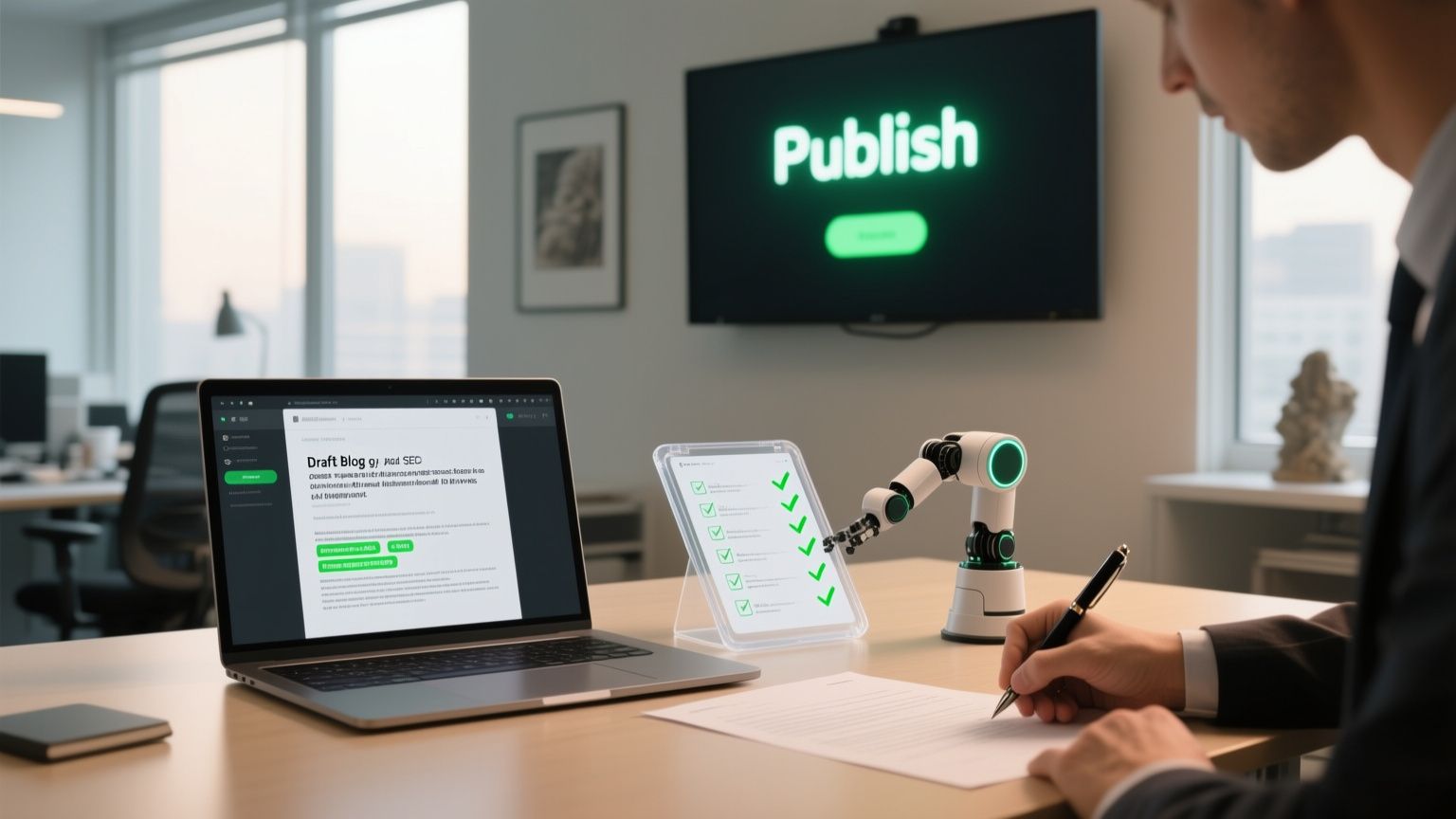
TL;DR – In 2026 agencies can run a fully‑automated, approval‑gated blog pipeline that delivers SEO‑rich, AI‑visible content at scale. The secret is a disciplined workflow built on SALP SEO’s AI SEO Operating System, clear governance checkpoints, and data‑driven optimization loops. This guide walks you through every prerequisite, the step‑by‑step process, common pitfalls, blueprint requirements, advanced scaling tips, and a side‑by‑side tool comparison.
---
1. Prerequisites
Before you press *run* on any automation, you need a solid foundation. Skipping any of these items will cause downstream re‑work, compliance headaches, or missed AI‑search opportunities.
1.1. Governance Framework
- Approval Gates – Define who must sign off at each stage (e.g., research, claim verification, final publish). SALP SEO recommends a 2‑human‑approval rule for pillar pages and 1‑human‑approval for supporting posts.
- SLAs – Set realistic turnaround times (e.g., 48 h for initial research review, 72 h for final publish) and embed them in your project management tool.
- Legal & Regulatory Checks – If you serve fintech, health, or other regulated verticals, embed prompt‑level checks that surface required disclosures before any AI‑generated claim is published.
1.2. Technical Stack
| Component | Recommended Tool | Why It Matters |
|---|---|---|
| Content Hub | SALP SEO OS (centralized dashboard) | Single source of truth for SEO, AI visibility, approvals, and reporting |
| Project Management | Asana / ClickUp with custom fields | Tracks mandatory fields (audience, evaluation criteria, evidence, review date) |
| Schema Generation | Structured Data Markup Helper (integrated in SALP) | Guarantees rich‑snippet eligibility for AI answers |
| Image Creation | Midjourney or DALL·E (prompt‑controlled) | Produces royalty‑free hero images without manual design time |
| Analytics | Google Search Console + SALP AI Insights | Monitors indexing, AI citation, and performance in one view |
1.3. Data Foundations
- Keyword & Topic Clusters – Use SALP’s AI‑driven discovery to pull 5‑10 high‑intent seed keywords per client niche, then expand into topic clusters (e.g., “AI‑search visibility”, “AI‑driven content governance”).
- Competitor Gap Matrix – Pull competitor pages, identify missing content themes, and tag each gap with a priority score.
- Evidence Repository – Store product evidence, case studies, and third‑party citations in a shared drive. Every claim in a draft must link back to an item in this repository.
---
2. Step‑by‑Step Process
Below is the end‑to‑end pipeline that agencies can copy‑paste into a SALP SEO blueprint. Each step includes the AI action, the human checkpoint, and the expected deliverable.
2.1. Discovery & Research (Day 0‑2)
- AI‑assisted Market Scan – Run SALP’s “AI Search Visibility” module to surface how the client’s brand appears across LLM‑driven answers, citations, and news.
- Human Review – A senior SEO strategist validates the relevance of the signals and adds any missing manual research (e.g., niche forums).
- Deliverable – A Research Brief (2‑page PDF) containing:
- Top 10 search intents
- Competitor citation map
- Sentiment heatmap
2.2. Keyword & Cluster Generation (Day 2‑4)
- AI Prompt – “Generate a seed list of 30 long‑tail keywords for a SaaS product that helps marketers automate blog publishing, grouped by intent (informational, transactional, navigational).”
- Human Curation – Remove low‑search‑volume terms, merge synonyms, and assign each keyword to a pillar or supporting post.
- Deliverable – Keyword Cluster Sheet with columns: Keyword, Search Volume, Intent, Assigned Asset Type, Priority.
2.3. Blueprint Creation (Day 4‑5)
| Asset Type | Pillar (H1) | Supporting Posts (H2‑H3) | Mandatory Fields |
|---|---|---|---|
| Pillar Page | “The Ultimate Guide to Automated Blog Publishing for Agencies” | 5‑7 sub‑topics (e.g., workflow automation, AI‑generated outlines, approval gating) | Target audience, Evidence links, Review date |
| Supporting Post | “How to Build an AI‑Approved Content Brief in 5 Minutes” | 3‑4 sub‑topics (prompt design, data sources, compliance) | Evaluation criteria, Pricing reference, Review date |
- AI Draft – SALP auto‑populates the blueprint with suggested headings, schema snippets, and internal‑link suggestions.
- Human Gate – Content lead verifies that each heading aligns with the client’s brand voice and that every claim has a citation.
- Deliverable – Blueprint Document (Google Sheet) ready for content generation.
2.4. Content Generation (Day 5‑7)
- Prompt Library – Use pre‑approved prompts stored in SALP’s “Prompt Vault”. Example:
Write a 1,200‑word section on "AI‑driven content brief creation" for a B2B SaaS audience. Include three real‑world examples, embed two schema.org FAQ blocks, and cite the 2024 Gartner report on AI content.
- AI Output – SALP runs the prompt through a vetted LLM (e.g., Claude‑3.5) and returns a draft with inline citation placeholders.
- Human Review – Two editors verify factual accuracy, tone, and that every placeholder links to an item in the Evidence Repository.
- Deliverable – Final Draft in markdown ready for enrichment.
2.5. Enrichment & Optimization (Day 7‑8)
- Schema Injection – SALP auto‑generates JSON‑LD for Article, FAQ, and Breadcrumbs based on the draft headings.
- Image Generation – Prompt: “Premium editorial hero image for automated blog publishing workflow explained for agencies, no text”. Upload the generated image to the CMS and add alt text with primary keyword.
- Internal Linking – SALP suggests three contextual links to existing client assets (case studies, product pages) and flags any broken links.
2.6. Approval & Publishing (Day 8‑9)
- Approval Workflow – The draft moves to the “Publish Queue” where the client’s brand manager and the agency’s legal lead must each click Approve.
- CMS Push – SALP’s integration with WordPress or Contentful publishes the article, sets canonical tags, and schedules a social‑share blast.
- Deliverable – Live URL + Publishing Checklist screenshot.
2.7. Indexing & Performance Monitoring (Day 9‑30)
- Index Check – SALP runs a 24‑hour post‑publish crawl to confirm Google and major LLMs have indexed the page.
- AI Citation Tracker – Monitors whether the article is cited in AI answers (e.g., Claude, Gemini). Alerts fire if citation drops.
- Performance Dashboard – Shows organic traffic, AI‑search impressions, CTR, and conversion metrics. Recommendations for next‑round optimization are auto‑generated.
---
3. Common Mistakes to Avoid
| Mistake | Why It Hurts | Corrective Action |
|---|---|---|
| Skipping the Evidence Check | AI can hallucinate; a single false claim can damage brand trust and trigger legal risk. | Enforce a mandatory “Evidence‑Link” field in every draft. Use SALP’s “Evidence‑First” toggle to block publishing until all links are verified. |
| Publishing Without Schema | AI answer engines prioritize structured data; missing schema reduces AI citation chances. | Run SALP’s schema validator before the final approval step. |
| One‑Size‑Fits‑All Prompt | Different content types (how‑to vs. case study) need distinct tone and depth. | Maintain a Prompt Vault with separate templates for each asset type. |
| Ignoring AI‑Search Signals | Traditional SEO metrics no longer capture the full visibility picture. | Add AI‑visibility KPIs (citation count, LLM impression share) to every client report. |
| Manual Copy‑Paste Reporting | Time‑consuming and error‑prone, leading to stale data. | Use SALP’s “Evidence‑First Reports” feature to auto‑generate executive‑ready PDFs. |
---
4. Blueprint Requirements (The Agency Playbook)
4.1. Mandatory Fields for Every Asset
- Target Audience – Persona name, pain points, and buying stage.
- Evaluation Criteria – How the content will be judged (traffic, AI citations, lead quality).
- Product Evidence – Direct links to data sheets, case studies, or third‑party research.
- Date of Review – Timestamp for compliance audits.
4.2. Governance Checklist
- [ ] Two‑Human Approval for pillar pages.
- [ ] One‑Human Approval for supporting posts.
- [ ] Legal Sign‑off for any pricing or regulatory claim.
- [ ] SEO Sign‑off confirming keyword placement, internal links, and schema.
- [ ] AI‑Visibility Sign‑off confirming that the page meets citation best practices (entity mentions, structured data, canonical tags).
4.3. Success Criteria
| Metric | Target (30‑Day) | Measurement Tool |
|---|---|---|
| Organic Sessions | +25 % vs. baseline | Google Analytics |
| AI Citation Count | ≥3 unique LLM citations | SALP AI Search Visibility |
| Avg. Time on Page | >3 min | GA4 |
| Conversion Rate (MQL) | >2 % | HubSpot |
| Indexing Speed | <24 h | SALP Index Checker |
---
5. Advanced Tips & Scaling Strategies
5.1. Agentic SEO Loops (2026)
Agentic SEO combines autonomous AI agents with human governance. In SALP, you can enable Agentic Mode for low‑risk assets (e.g., industry news round‑ups). The AI agent will:
- Pull the latest data.
- Draft the article.
- Auto‑populate the approval checklist.
- Notify the human reviewer only if a confidence threshold falls below 92 %.
5.2. Multi‑Channel Syndication
After publishing, use SALP’s Syndicate Smarter module to push the article to:
- Partner newsletters
- Industry portals (e.g., MarketingProfs, Search Engine Journal)
- Community platforms (e.g., Indie Hackers, Product Hunt)
- AI‑driven content aggregators (e.g., Feedly AI, Jasper AI Hub)
Each syndication channel gets a canonical tag pointing back to the original blog URL, preserving link equity.
5.3. Pricing & ROI Modeling for Agencies
| Service Tier | Monthly Cost (USD) | Expected Output | ROI Timeline |
|---|---|---|---|
| Starter | $2,500 | 4 pillar + 12 supporting posts | 3‑4 months |
| Growth | $5,800 | 8 pillar + 24 supporting posts + AI citation monitoring | 2‑3 months |
| Enterprise | $12,000 | Unlimited content, dedicated AI agent, custom dashboards | 1‑2 months |
Use these numbers to build a client proposal calculator that shows projected traffic lift and lead generation against the agency fee.
---
6. Tool Comparison: Refine AI vs. Ayzeo vs. Baarely (For Agencies & SaaS)
| Feature | Refine AI | Ayzeo | Baarely |
|---|---|---|---|
| AI Model | Claude‑3.5 (OpenAI‑compatible) | Gemini‑1.5 (Google) | Llama‑3 (Meta) |
| Prompt Library | Built‑in, agency‑focused templates | Basic, no versioning | Community‑driven, limited governance |
| Human Approval Workflow | Integrated with SALP OS (approval‑gated) | Manual export/import only | No native approval gate |
| Pricing (per 1M tokens) | $12 | $9 | $7 |
| AI‑Search Visibility Module | Yes (tracks citations, LLM impressions) | No | No |
| Schema Automation | Auto‑generate JSON‑LD for FAQ, Article, Breadcrumbs | Requires plugin | Manual only |
| Enterprise Governance | Role‑based access, audit logs, legal checks | Single‑admin only | None |
| Best For | Agencies needing strict compliance and AI‑search tracking | SaaS teams focused on cost‑effective generation | Small blogs with low compliance needs |
Takeaway: For agencies that must prove factual accuracy, maintain audit trails, and monitor AI citations, Refine AI (the SALP‑powered offering) is the only platform that bundles all required governance features.
---
7. Summary Table – The End‑to‑End Workflow at a Glance
| Phase | AI Action | Human Gate | Key Output |
|---|---|---|---|
| Discovery | Market & AI‑visibility scan | SEO strategist validates intent | Research Brief |
| Keyword Clustering | Generate seed list & clusters | Content lead curates list | Keyword Cluster Sheet |
| Blueprint | Auto‑populate headings & schema | Senior editor approves structure | Blueprint Document |
| Drafting | Prompt‑driven article generation | Dual‑editor fact‑check & tone review | Final Draft (Markdown) |
| Enrichment | Schema injection, image creation | SEO lead verifies markup | Enriched Article |
| Approval | Push to Publish Queue | Client brand manager & legal sign‑off | Publish Checklist |
| Publish | CMS API push | None (post‑approval) | Live URL |
| Post‑Publish | Index check, AI citation monitor | Analyst reviews alerts | Performance Dashboard |
---
FAQ
- What is an “approval‑gated” workflow and why is it essential?
- An approval‑gated workflow forces every AI‑generated asset to pass through one or more human reviewers before it goes live. This prevents hallucinations, ensures brand voice consistency, and satisfies legal/compliance requirements—especially critical for agencies handling multiple client brands.
- Can I completely eliminate human reviewers with SALP SEO?
- No. SALP is built on the premise of AI‑powered, human‑approved processes. While AI can draft, research, and suggest optimizations, the platform disables publishing actions until the required approvals are logged.
- How does SALP help my agency win AI‑search citations?
- SALP monitors 25M+ sources for AI answer citations, surfaces gaps in entity signals, and recommends schema or content tweaks that increase the likelihood of being quoted in LLM‑generated answers.
- Is the workflow the same for SaaS vs. B2C agencies?
- The core steps are identical, but SaaS clients often need additional product‑evidence fields (pricing tables, integration lists) and tighter regulatory checks. Adjust the mandatory fields and approval matrix accordingly.
- What happens if an AI‑generated claim is later disproven?
- SALP’s Evidence‑First Alerts flag any claim that loses its citation (e.g., a study is retracted). The system creates a task for the content owner to update or remove the claim, keeping the site trustworthy.
- How do I measure ROI on an automated blog pipeline?
- Track incremental organic sessions, AI citation count, MQL conversion rate, and time saved on manual copy‑pasting. SALP’s built‑in reporting can export these metrics into a single PDF for client billing.
- Can the workflow be extended to video or podcast assets?
- Yes. The same blueprint can include “media asset” rows with fields for transcript generation, AI‑generated show notes, and schema for
VideoObjectorPodcastEpisode.
---
Conclusion
In 2026 the competitive edge for agencies is no longer “who can write the most blog posts” but who can deliver AI‑search‑ready, evidence‑backed content at scale while staying compliant. By adopting the approval‑gated workflow outlined above—grounded in SALP SEO’s AI SEO Operating System—you gain:
- Speed: AI drafts in minutes, human reviews in hours.
- Control: Role‑based approvals, audit logs, and legal checks.
- Visibility: Real‑time monitoring of AI citations, sentiment, and competitor moves.
- Scalability: Agentic loops and automated syndication let you multiply output without sacrificing quality.
Implement the checklist, train your team on the SALP platform, and watch your agency’s blog network become a trusted source for both traditional search and the next generation of AI‑driven discovery.
---
Call to Action
Ready to future‑proof your agency’s content engine? Explore Salp SEO for next steps.
For Pr Professionals | SALP SEO
AI SEO Workflows for Agencies: From Data Chaos to Predictable Growth | SALP SEO
AI SEO Best Practices: Build Content That Earns Trust, Not Just Rankings | SALP SEO
Citation Autopilot: Build Trustworthy ChatGPT Sources Without the Copy-Paste Grind | SALP SEO
Inside a 2026 Automated SEO Content Factory: 7 Campaigns That Scaled | SALP SEO