Competitor Research Workflows for SEO Teams
Learn practical, step-by-step competitor research workflows for SEO teams, including prerequisites, process, common mistakes, blueprint requirements, and practical tips f
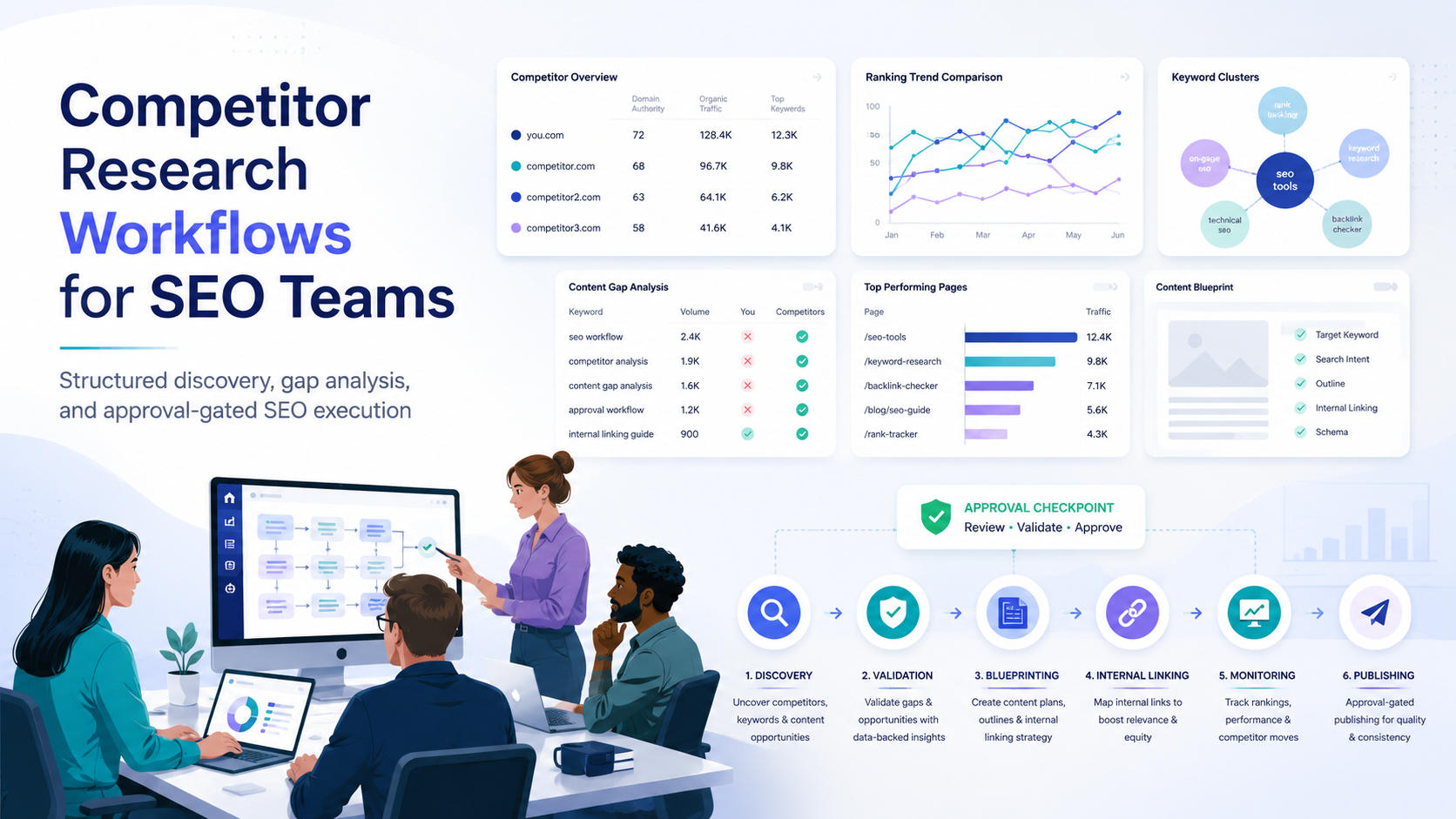
<h1>Competitor Research Workflows for SEO Teams</h1>
<p>In the evolving world of SEO, knowing what your competitors are doing—and why they’re succeeding or failing—is as critical as optimizing your own pages. This guide offers a practical, field-tested workflow for SEO teams that want structured, auditable competitor research powered by disciplined processes and human approval gates. We’ll cover prerequisites, a step-by-step process, common mistakes to avoid, blueprint requirements, and real-world examples you can adapt today.</p>
Prerequisites
- <strongGovernance and policy:</strong> A documented content approval policy that requires human review before publishing any AI-assisted or officially initiated content changes. Include roles, SLAs, and escalation paths.
- <strongData foundations:</strong> A centralized repository of target keywords, content inventory, ranking positions, and competitor references. Ensure mapping between content clusters and business goals.
- <strongTeam roles:</strong> Define ownership for each stage: researcher, data analyst, content strategist, legal/compliance liaison, brand editor, and publishing approver. Clarify decision rights and handoff criteria.
- <strongTechnical readiness:</strong> A lightweight workflow dashboard or project board that can track statuses (discovery, validation, drafting, review, publish, monitor) and indexing health checks.
- <strongQuality controls:</strong> Establish checks for accuracy, brand voice alignment, and factual correctness. Include a mechanism to capture feedback and iteratively improve the process.
Real-world example: onboarding a new competitor research project
- Create a project template with fields: target competitor, core topics, content gaps, ranking signals, and potential optimization opportunities.
- Assign ownership: SEO analyst (discovery), content strategist (gap analysis), brand editor (tone/voice), and publishing approver (final sign-off).
- Set SLAs: discovery within 2 business days, draft within 3 days, review within 2 days, publish within 5 days after approval.
Step-by-step process
1) Discovery and scope definition
- Identify the question you’re answering: Where do competitors outperform us in topics, content formats, or channels? How are they achieving visibility gains?
- Choose a scope: a set of core competitors, a defined time window, and a target topic cluster (e.g., onboarding content for SaaS products).
- Gather signals: keyword coverage, content formats (long-form guides, FAQs, video), backlink profiles, internal linking opportunities, and on-page optimizations.
2) Data collection and validation
- Collect public signals: rankings, content pieces, publication dates, and update cadence.
- Validate data quality: ensure sources are reliable, and note any gaps or biases.
- Document assumptions: how you defined “topic coverage,” how you treated multi-variant pages, and any normalization steps.
3) Gap analysis and opportunity mapping
- Content gaps: where competitors discuss topics you barely touch or omit entirely.
- Tactical gaps: internal linking opportunities, schema opportunities, and multimedia formats missing from your pages.
- Prioritize opportunities: impact vs. effort, aligned with buyer intent and your product roadmap.
4) Clustering and blueprint creation
- Cluster content into a logical taxonomy (clusters, pillars, and satellites).
- Create a blueprint for each cluster: target pages, suggested angles, and a proposed publishing sequence.
- Incorporate approval gates: ensure each blueprint includes a human review step before any content is produced or published.
5) Content generation and optimization plan
- Draft content plans that align with buyer intent and search intent discovered in competitor content.
- Define success signals: what metrics will indicate success (traffic, engagement, conversions) and how they will be measured post-publish.
- Build an optimization checklist: canonicalization, internal links, schema, meta hints, and accessibility checks.
6) Review, approvals, and publishing
- Run a formal review cycle with stakeholders (content strategist, brand editor, legal/compliance as needed).
- Ensure all content passes the approval criteria before indexing or live publishing.
- Publish and monitor indexing status and early performance signals.
7) Monitoring and iteration
- Set up a lightweight dashboard to monitor impressions, clicks, CTR, average position, and indexing health for published pages.
- Schedule quarterly reviews of competitor movements and adjust blueprints accordingly.
- Capture lessons learned and incorporate them into templates and playbooks.
Common mistakes and how to avoid them
- <strongMistake 1:</strong> Failing to define the exact scope and success criteria. <em>Fix:</em> Establish clear goals, success metrics, and a published scope document that all stakeholders sign off on.
- <strongMistake 2:</strong> Relying on automated, unchecked outputs. <em>Fix:</em> Always route outputs through human approvals and maintain an auditable trail of decisions.
- <strongMistake 3:</strong> Treating competitors’ content as gospel instead of benchmarking. <em>Fix:</em> Use competitor signals as directional inputs, not definitive prescriptions.
- <strongMistake 4:</strong> Uneven internal linking and silo structure. <em>Fix:</em> Map opportunities to your existing content architecture to maximize discovery and context.
- <strongMistake 5:</strong> Ignoring seasonal or product lifecycle shifts. <em>Fix:</em> Incorporate time-bound updates and product roadmaps into the research cadence.
Blueprint requirements
- <strongContent inventory mapping:</strong> Link all topics from competitors to your own content inventory, identifying coverage gaps and potential repurposing opportunities.
- <strongApproval criteria:</strong> Define the exact criteria that content must meet before publishing (tone, factual accuracy, citations, and brand alignment).
- <strongIndexing plan:</strong> Include a plan for indexing checks, canonical tags, and URL hygiene to prevent duplicate or conflicting signals.
- <strongGovernance policy:</strong> Document SLAs, escalation paths, and roles for each stage of the process.
- <strongPerformance dashboards:</strong> A lightweight dashboard showing key metrics (impressions, clicks, CTR, average position, indexing status).
Example blueprint snippet
- Cluster: “Onboarding for SaaS”
- Gap: Competitors publish step-by-step onboarding checklists not covered by us.
- Action: Create a pillar page plus 3 supporting articles.
- Approval: Content lead approves all blueprint components before drafting begins.
- Indexing: Confirm canonical and internal links from pillar to satellites.
Real-world applications and practical tips
- Practical tip 1: Start with a pilot cluster for a high-priority topic and iterate. Map crawl signals to your internal linking plan so early changes reinforce discovery.
- Practical tip 2: Use a lightweight approval policy and one-page SLA to keep momentum while maintaining quality.
- Practical tip 3: Align content angles with buyer personas to ensure relevance in AI-assisted outputs.
- Practical tip 4: Include schema and structured data checks in the blueprint to improve chances of rich results and better AI recognition.
- Practical tip 5: Regularly refresh competitive signals. Competitors evolve, and your workflows should adapt accordingly.
Comparison: traditional vs approval-gated AI-driven competitor research
| Aspect | Traditional workflow | Approval-gated AI-driven workflow |
|---|---|---|
| Speed | Moderate to slow due to manual steps | Faster, with structured gates that preserve quality |
| Quality controls | Manual reviews | Human approvals embedded at every content creation step |
| Traceability | Limited documentation | Full audit trail of decisions and changes |
| Risk | Higher risk of publishing low-quality content | Reduced risk through explicit checks and sign-offs |
Practical takeaway: Approval gates don’t slow you down; they provide a disciplined, scalable path to high-quality, competitive content that can be trusted across teams.
Quick-start checklist
- Define your pilot topic cluster and the key competitors.
- Create a blueprint with clear approval criteria and SLAs.
- Map competitor signals to your content inventory and identify gaps.
- Establish a lightweight dashboard for indexing and engagement metrics.
- Schedule a первых review with brand, legal, and content leads before publishing.
Summary and key takeaways
- A well-scoped competitor research workflow combines discovery, data validation, gap analysis, blueprinting, and gated publishing.
- Human approvals at each stage help maintain brand integrity and accuracy, especially when using AI-assisted content creation.
- Clustering content into pillars and satellites improves discovery and helps structure editorial calendars.
- Continuous monitoring and iterative improvements are essential as competitors evolve and search ecosystems shift.
FAQ
- What is the purpose of an approval gate in competitor research workflows?
- To ensure content accuracy, brand alignment, and compliance before publishing, reducing risk and maintaining quality.
- How should I prioritize opportunities found in competitor research?
- Use impact vs effort, alignment with buyer intent, and feasibility within your product roadmap as guiding criteria.
- How often should we revisit competitor signals?
- Schedule a quarterly review, with lighter monthly checks to capture fast-moving changes.
- What metrics should we monitor post-publish?
- Impressions, clicks, CTR, average position, and indexing health; monitor engagement signals and conversion metrics where possible.
- How do we avoid duplicating content when targeting similar topics as competitors?
- Maintain a clear content taxonomy, use canonicalization wisely, prevent overlap with interlinked pillar pages, and ensure unique value propositions.
- What should a minimal viable blueprint include?
- Target cluster, identified gaps, proposed content pieces, approval criteria, indexing plan, and publishing timeline.
Conclusion
Competitor research is not just about copying rivals; it’s about learning where opportunities lie, validating ideas through human oversight, and building a scalable content system that adapts to changing AI and traditional search dynamics. By combining structured discovery, rigorous blueprints, and disciplined approvals, SEO teams can drive meaningful growth while maintaining brand integrity and governance across all content initiatives.
CTA
Explore Salp SEO for next steps in building your approval-gated AI SEO workflows, onboarding your team to scalable competitor research, and turning insights into actionable content that resonates with your audience.
SALP SEO - AI SEO Intelligence Platform
SALP SEO - AI SEO Intelligence Platform