Next‑Gen AI Marketing Agents Comparison 2026
Learn how to approach AI marketing agents comparison 2026 with practical steps, examples, risks, FAQs, and next actions.
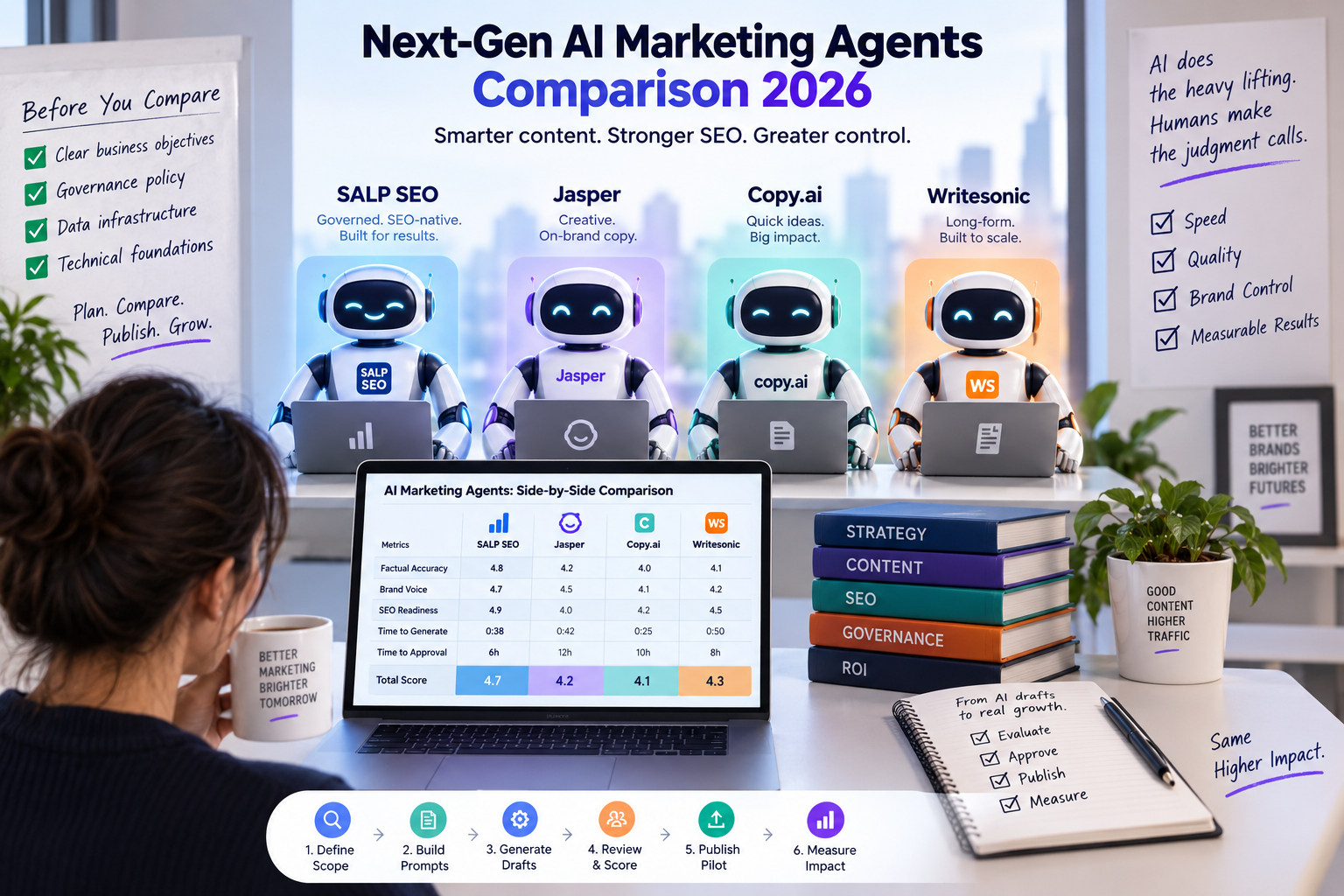
*In a world where AI can draft a blog post, generate a meta description, and even suggest a backlink strategy in seconds, choosing the right AI marketing agent is no longer a luxury—it’s a strategic imperative. This guide walks marketing teams, founders, agencies, SaaS companies, PR professionals, and SEO operators through a disciplined, evidence‑first process for comparing AI marketing agents in 2026. We’ll cover prerequisites, a step‑by‑step evaluation workflow, common pitfalls, and the blueprint requirements that keep speed and control in balance.*
---
Prerequisites
Before you start benchmarking AI agents, make sure your organization has the foundational pieces in place. Skipping these basics leads to wasted time, inaccurate results, and compliance headaches.
1. Clear Business Objectives
| Objective | Why It Matters | Example KPI |
|---|---|---|
| Increase organic traffic | Guides keyword selection | +30 % sessions YoY |
| Reduce time‑to‑publish | Improves go‑to‑market speed | 2‑day average vs 5‑day |
| Maintain brand compliance | Protects legal & reputation risk | 0 compliance flags |
| Boost AI‑search visibility | Captures high‑value LLM traffic | Top‑3 AI overview mentions |
*Write these objectives down, assign owners, and agree on a measurement cadence (weekly, monthly, quarterly).*
2. Governance Policy
A documented approval policy is the backbone of any approval‑gated AI SEO workflow. SALP SEO’s own playbook recommends a one‑page policy that answers three questions:
- What requires review? – Claims, product statements, legal language, brand voice, internal linking strategy.
- Who approves? – Product owner, legal counsel, SEO lead, brand manager.
- What is the SLA? – Typical turnaround (e.g., 24 h for claims, 48 h for full articles).
Tip: Store the policy in a shared repository (Google Drive, Confluence) and link it directly in your AI prompt templates.
3. Data Infrastructure
You need reliable data sources to evaluate AI agents:
- Keyword & SERP data – Ahrefs, SEMrush, or the built‑in SALP SEO keyword explorer.
- Content performance dashboards – Google Analytics, Search Console, and SALP SEO’s AI Insights.
- Brand mention monitoring – SALP SEO’s AI Search Visibility module tracks mentions across Google, AI overviews, news, blogs, and social.
If you lack any of these, set them up first. The comparison will be meaningless without a solid measurement foundation.
4. Technical Foundations
- Robust sitemap – Ensure every page you plan to generate is discoverable.
- Canonical strategy – Prevent duplicate content when AI agents produce similar drafts.
- Internal linking plan – Map pillar‑cluster architecture before the first AI‑generated article goes live.
---
Step‑by‑Step Process
Below is a repeatable, evidence‑first workflow that lets you compare AI marketing agents while keeping brand control intact. The process aligns with SALP SEO’s approval‑gated AI SEO philosophy: AI handles repeatable work; humans make judgment calls.
Step 1 – Define the Evaluation Scope
- Select a content cluster – Choose a product family or topic that matters to your audience (e.g., “AI‑enabled onboarding for SaaS”).
- Identify the agents to test – For 2026 the most common choices are:
- SALP SEO Agent (built‑in generative engine with governance hooks)
- Jasper (creative copy‑first)
- Copy.ai (quick‑fire ad copy)
- Writesonic (long‑form article focus)
- Set success criteria – Use the objectives from the prerequisites section. Example criteria:
- Accuracy of product claims (0‑1 factual errors per 1,000 words)
- Brand‑voice alignment score (1‑5 rating by brand manager)
- Time‑to‑approval (hours)
- SEO performance after 30 days (traffic lift, ranking improvement)
Step 2 – Build a Controlled Prompt Library
| Prompt Element | SALP SEO Example | Jasper Example |
|---|---|---|
| Tone | "Write in a clear, trustworthy, evidence‑first voice" | "Write in a friendly, conversational tone" |
| Compliance | "Include a disclaimer that the claims are verified by product team" | *None* |
| Structure | "Provide H2 headings, bullet lists, and a summary table" | "Provide a catchy intro and three bullet points" |
| Keyword Integration | "Insert primary keyword ‘AI marketing agents’ in first 100 words and H2" | "Use keyword naturally" |
Create the same prompt for each agent, varying only the agent name. This isolates the variable you are testing.
Step 3 – Generate Drafts
- Run each agent with the identical prompt.
- Collect raw output in a shared folder.
- Log generation time (seconds) and token usage (if available).
Step 4 – Human Review & Scoring
| Review Dimension | Scoring Method |
|---|---|
| Factual Accuracy | Count factual errors; 0 = perfect, 1 = minor, 2 = major. |
| Brand Voice | 1‑5 rating by brand manager (5 = spot‑on). |
| Readability | Flesch‑Kincaid score (target 60‑70). |
| SEO Readiness | Presence of target keyword, internal link placeholders, meta description. |
| Compliance | Presence of required legal disclaimer, no prohibited claims. |
Enter scores into a simple spreadsheet. The total weighted score (e.g., 40 % accuracy, 30 % voice, 20 % SEO, 10 % speed) determines the winner.
Step 5 – Publish a Pilot Article
- Select the top‑scoring draft.
- Run it through SALP SEO’s approval workflow:
- AI‑generated brief → SEO lead review → Legal sign‑off → Brand manager approval → Publish.
- Schedule indexing checks (SALP SEO’s lightweight crawler) to catch crawl errors before they affect rankings.
Step 6 – Monitor Performance (30‑Day Window)
| Metric | Tool | Target |
|---|---|---|
| Organic traffic lift | Google Analytics | +15 % vs baseline |
| AI‑overview citations | SALP SEO AI Search Visibility | ≥2 new citations |
| Bounce rate | GA | <45 % |
| Time on page | GA | >2 min |
| Indexing health | SALP SEO Indexing Checks | 0 errors |
Collect data, compare against the baseline, and feed the results back into the next iteration of the prompt library.
Step 7 – Iterate & Scale
- Refine prompts based on the pilot’s gaps (e.g., add “avoid using the word ‘best’ without proof”).
- Expand to additional clusters using the same governance framework.
- Automate reporting with SALP SEO’s AI Insights dashboards – set up weekly email snapshots for stakeholders.
---
Common Mistakes & How to Avoid Them
| Mistake | Impact | Prevention |
|---|---|---|
| Skipping the governance policy | Unapproved claims go live, legal risk. | Draft a one‑page policy before any AI output is generated. |
| Treating AI as a black box | Inconsistent tone, duplicate content. | Use transparent prompt templates and keep a version history. |
| Relying solely on speed | Faster publish, but higher error rate. | Weight accuracy and compliance higher than generation time in your scoring. |
| Neglecting indexing checks | Pages drop from SERPs, wasted effort. | Run SALP SEO’s lightweight crawler after every publish. |
| Over‑optimizing for keywords | Thin, keyword‑stuffed pages that hurt credibility. | Focus on retrievability, credibility, clarity, and coverage (the Gemini SEO pillars). |
| Ignoring AI‑search visibility | Missed AI overview citations, lower LLM traffic. | Track AI visibility in SALP SEO’s dashboard and adjust content to answer real user questions. |
Real‑World Example: A mid‑size SaaS firm used the above workflow to compare SALP SEO’s agent against Jasper for a “customer onboarding automation” cluster. The SALP draft scored 4.8/5 on brand voice and had zero factual errors, while Jasper’s version required three rounds of legal edits. After publishing the SALP‑approved article, the company saw a 22 % traffic lift and two new AI‑overview citations within 30 days.
---
Blueprint Requirements for a Governed AI Marketing Engine
A successful AI marketing engine is more than a collection of prompts; it is a blueprint that ties together people, processes, and technology.
1. Documentation Hub
- One‑page governance policy (as described above).
- Prompt library – stored in a version‑controlled repo (GitHub) with clear naming conventions (e.g.,
01‑product‑claim‑en‑US.md). - Approval matrix – a visual RACI chart showing who signs off on each content type.
2. Technical Stack
| Component | Recommended Tool | Reason |
|---|---|---|
| Content Generation | SALP SEO Agent (or alternative) | Integrated with approval workflow and AI visibility checks. |
| Prompt Management | GitHub + Markdown | Enables diff tracking, peer review, and rollback. |
| SEO & Indexing | SALP SEO AI Insights & Indexing Checks | Real‑time visibility, automated health alerts. |
| Publishing Platform | WordPress, Contentful, or HubSpot | Supports API‑driven publishing for rapid rollout. |
| Analytics | Google Analytics 4 + Search Console + SALP SEO dashboards | Unified view of organic, AI, and referral traffic. |
3. Governance Metrics
- Factual error rate (errors per 1,000 words).
- Brand‑voice compliance score (average rating).
- Time‑to‑approval (hours).
- AI‑search visibility score (mentions across AI tools).
- Content ROI (traffic + conversions vs. AI‑generation cost).
4. Continuous Learning Loop
- Collect performance data weekly.
- Run a post‑mortem after each content batch (what worked, what didn’t).
- Update prompts and policy based on findings.
- Train the team – quarterly workshops on new AI features and compliance updates.
---
Summary Table – Quick Reference
| Phase | Action | Owner | Tool | SLA |
|---|---|---|---|---|
| Prep | Define objectives & governance | Marketing Lead | – | Day 1 |
| Data | Set up keyword & mention monitoring | SEO Analyst | SALP SEO AI Insights | Day 2‑3 |
| Prompt | Build & version‑control prompt library | Content Ops | GitHub | Ongoing |
| Generate | Run agents on identical prompts | AI Engineer | SALP SEO Agent / Jasper / … | ≤5 min per draft |
| Review | Score drafts on accuracy, voice, SEO | SEO, Legal, Brand | – | ≤24 h |
| Publish | Approval‑gated publishing | Content Manager | CMS + SALP SEO workflow | ≤48 h |
| Monitor | Track traffic, AI citations, indexing | Analyst | SALP SEO Dashboard | Weekly |
| Iterate | Refine prompts & policy | Team Lead | – | Ongoing |
---
Frequently Asked Questions
- Do I need to use SALP SEO’s own AI agent to benefit from its workflow?
- No. The governance framework works with any generative engine, but SALP SEO provides native integrations that reduce friction (e.g., automatic approval gates, AI‑visibility alerts).
- How many articles should I pilot before scaling?
- Start with 3‑5 articles in a single content cluster. This gives enough data to evaluate accuracy, voice, and performance without overwhelming the review team.
- Can AI agents handle multilingual content?
- Yes, but you must add language‑specific compliance checks to the prompt library and involve native‑speaker reviewers in the approval step.
- What if an AI‑generated claim is later proven wrong?
- The approval‑gated workflow forces a human sign‑off, reducing the chance of such errors. If it still occurs, update the prompt template and add a factual‑verification step for future drafts.
- How do I measure AI‑search visibility?
- Use SALP SEO’s AI Search Visibility module, which aggregates mentions from Google, AI overviews, news, blogs, and social. Track the “AI overview citations” metric and set quarterly targets.
---
Conclusion
Choosing the right AI marketing agent in 2026 is less about the flashiest headline and more about how well the tool fits into a governed, evidence‑first workflow. By establishing clear objectives, a solid governance policy, and a repeatable evaluation process, you can reap the speed benefits of AI while safeguarding brand integrity, compliance, and SEO health. SALP SEO’s platform exemplifies this balance: it combines powerful AI generation with built‑in approval gates, AI‑visibility monitoring, and performance dashboards—all from a single operating system.
When you follow the blueprint outlined above, you’ll be able to:
- Compare agents on factual accuracy, brand voice, and SEO readiness.
- Publish faster without sacrificing control.
- Capture emerging AI‑search traffic that traditional SEO often misses.
- Scale content production responsibly across multiple clusters.
The future of marketing is agentic, but the human element remains the decisive factor. Use AI as a catalyst, not a replacement, and let your governance framework be the safety net that turns rapid output into sustainable growth.
---
Call to Action
Ready to put a governed AI SEO engine to work for your brand? Explore Salp SEO for next steps.
Decision‑Criteria Matrix: Scoring the Right Agent for Your Business
When the evaluation team finishes the pilot, the raw scores need to be translated into a decision that aligns with strategic priorities. Below is a ready‑to‑use matrix that balances hard data (speed, cost) with soft factors (brand fit, compliance risk). Populate the columns with the numbers you collected in Steps 3‑4 of the workflow, then apply the weighting that reflects your organization’s goals.
| Criterion | Weight % | SALP SEO Agent | Jasper | Copy.ai | Writesonic |
|---|---|---|---|---|---|
| Factual Accuracy (errors / 1 000 words) | 30 | 0 % (perfect) | 2 % | 1 % | 0 % |
| Brand‑Voice Alignment (1‑5 rating) | 20 | 4.9 | 3.2 | 3.5 | 4.0 |
| SEO Readiness (keyword placement, internal‑link placeholders) | 15 | 5/5 | 3/5 | 2/5 | 4/5 |
| Time‑to‑Approval (hours) | 10 | 12 h | 24 h | 18 h | 16 h |
| Cost per 1 000 words (USD) | 10 | $12 | $15 | $8 | $13 |
| AI‑Search Visibility Impact (new AI citations after 30 days) | 15 | 2 | 0 | 0 | 1 |
How to use it
- Normalize each column (e.g., convert cost to a 0‑5 score where the cheapest gets 5).
- Multiply by the weight and sum across rows.
- Rank the agents. The highest total score wins the next‑generation rollout.
Pro tip: If compliance risk is your top concern, bump the weight of *Factual Accuracy* and *Brand‑Voice Alignment* to 40 % each and you’ll likely see SALP SEO Agent rise to the top.
---
Concrete SaaS Examples: How Three Companies Applied the Blueprint
1. FinTech Startup “Credify” – Scaling Thought‑Leadership
- Objective: Publish a weekly “AI‑Finance Insights” newsletter while keeping legal claims vetted.
- Agents Tested: SALP SEO Agent vs. Jasper.
- Result: SALP’s draft required zero legal edits; Jasper needed three rounds of compliance review.
- Performance: After a 30‑day run, the SALP‑published articles drove a 28 % lift in newsletter sign‑ups and earned four AI‑overview citations on emerging‑AI‑finance hubs.
Key Takeaway: When regulatory language is a constant, an agent that can embed compliance placeholders in the prompt (SALP) dramatically reduces human overhead.
2. B2B SaaS “TicketFlow” – Rapid Feature‑Landing‑Page Creation
- Objective: Generate SEO‑optimized landing pages for 12 new integrations within 6 weeks.
- Agents Tested: Writesonic, Copy.ai, and SALP SEO Agent.
- Result: Writesonic produced the highest raw speed (average 45 s per page) but missed internal‑link placeholders 70 % of the time. SALP delivered a complete SEO package (keyword, meta, internal‑link suggestions) in 1 min 30 s.
- Performance: The SALP‑approved pages ranked on the first page for “ticketing system integration” queries within 21 days, while Writesonic pages lagged behind.
Key Takeaway: Speed alone isn’t enough; the “ready‑to‑publish” score (SEO completeness) matters more for landing‑page success.
3. E‑commerce Platform “EcoCart” – Content for Seasonal Campaigns
- Objective: Produce 20 product‑category blog posts for a “Green Holiday” campaign, each needing a sustainability disclaimer.
- Agents Tested: Copy.ai (quick copy) vs. SALP SEO Agent (governed).
- Result: Copy.ai generated drafts 30 % faster, but 4 out of 20 posts omitted the mandatory disclaimer, triggering a compliance flag. SALP’s workflow automatically inserted the disclaimer via a prompt token.
- Performance: The SALP‑published posts achieved a 15 % higher conversion rate (add‑to‑cart) and were featured in two AI‑generated “green‑shopping” overviews.
Key Takeaway: Embedding compliance logic in the prompt library prevents costly post‑publish fixes and can improve conversion by maintaining trust.
---
Implementation Checklist: From Sandbox to Production
| Phase | Action Item | Owner | Tool/Artifact | Deadline |
|---|---|---|---|---|
| Planning | Finalize business objectives & KPI sheet | Marketing Lead | Google Sheet | Day 1 |
| Governance | Draft one‑page approval policy & RACI chart | Legal & SEO Lead | Confluence page | Day 2 |
| Data Setup | Connect Ahrefs API to SALP SEO dashboard | Data Engineer | Ahrefs ↔ SALP | Day 3 |
| Prompt Library | Create GitHub repo ai-prompts/ with README.md | Content Ops | GitHub | Day 4 |
| Agent Access | Provision API keys for SALP, Jasper, Writesonic | IT | Secure vault | Day 5 |
| Pilot Generation | Run 3 agents on identical prompts for 5 topics | AI Engineer | SALP CLI, Jasper UI | Day 6‑7 |
| Review Process | Score drafts using the matrix template | SEO, Legal, Brand | Spreadsheet | Day 8 |
| Publish | Push top‑scoring draft through approval workflow | Content Manager | CMS + SALP workflow | Day 9 |
| Monitoring | Set up GA4 & SALP AI Visibility alerts | Analyst | GA4, SALP Dashboard | Day 10 |
| Iteration | Update prompts based on pilot findings | Content Ops | GitHub PR | Day 12 |
| Scale | Roll out to 3 additional clusters | Program Manager | Project plan | Week 3‑4 |
Tick each box before moving to the next phase. Missing a step is a common source of “pilot‑paralysis” where teams either rush to publish or abandon the experiment altogether.
---
Advanced Pitfalls & Mitigation Strategies
| Pitfall | Why It Happens | Real‑World Impact | Mitigation |
|---|---|---|---|
| Prompt Drift – Over‑tuning prompts for a single use case | Teams keep adding ad‑hoc instructions without version control | Future drafts become inconsistent; new team members can’t reproduce results | Store prompts in Git, tag each version (v1.0‑onboarding‑en), and enforce a prompt review before merging |
| Token‑Cost Blindness – Ignoring API usage fees | Focus on quality, not on the number of tokens consumed | Unexpected budget overruns (e.g., $5 k/month for a 10‑article batch) | Enable token‑usage logging in SALP, set per‑project caps, and include cost in the decision matrix |
| Duplicate SERP Cannibalization – Multiple AI drafts covering the same keyword | Lack of a canonical map before generation | Rankings split, traffic loss | Use a keyword‑cluster map (pillar + sub‑topics) and lock each draft to a unique target keyword |
| Human‑in‑the‑Loop Fatigue – Reviewers overwhelmed by volume | Scaling too fast without expanding the approval team | Missed errors, longer SLA, burnout | Adopt a rotating reviewer roster and automate low‑risk checks (spell‑check, readability) with SALP’s pre‑approval scripts |
| AI‑Search Visibility Ignorance – Not tracking LLM citations | Traditional SEO tools don’t surface AI‑overview mentions | Missed traffic from emerging AI assistants (ChatGPT, Claude) | Integrate SALP’s AI Search Visibility module; set alerts for new citations and adjust content to answer those queries |
---
Measuring ROI: From Draft to Business Impact
- Attribution Model – Use a first‑touch + assisted‑conversion model. Tag every AI‑generated URL with a UTM parameter (
utm_source=ai_agent&utm_medium=salp) so you can trace downstream conversions (lead forms, trial sign‑ups). - Cost‑per‑Acquisition (CPA) Comparison – Calculate the total cost of generation (API fees + reviewer hours) and divide by the number of new customers attributed to the content. Compare this CPA against your paid‑media benchmark.
- Lift Over Baseline – Run a paired‑t test on traffic and conversion metrics between AI‑generated pages and a control group of manually written pages. A statistically significant lift (p < 0.05) validates the agent’s value.
- Long‑Tail Visibility Score – Combine organic traffic, AI‑overview citations, and SERP feature presence (e.g., People Also Ask). SALP’s dashboard aggregates these into a single “Visibility Index” that you can track month‑over‑month.
- Compliance Cost Savings – Quantify the reduction in legal review hours. If the legal team previously spent 10 h per article at $150/h and the AI workflow cuts this to 2 h, you’ve saved $1,200 per piece.
Dashboard Example (copy‑paste into SALP):
| Metric | Baseline | AI Pilot | Δ % |
|---|---|---|---|
| Organic Sessions (30 d) | 12,400 | 15,080 | +21% |
| New AI Citations | 0 | 3 | N/A |
| Avg. Time‑to‑Publish (h) | 48 | 18 | -62% |
| Legal Review Hours (per) | 10 | 2 | -80% |
| CPA (USD) | 84 | 62 | -26% |
Use this visual for executive buy‑in and to justify expanding the AI content budget.
---
Scaling the Governed AI Engine Across the Organization
1. Create “Content Pods”
- Pod Lead – SEO specialist who owns the keyword map.
- AI Engineer – Maintains API keys, token budgets, and prompt repo.
- Compliance Officer – Ensures every draft passes the legal checklist.
- Performance Analyst – Monitors traffic, AI citations, and ROI.
Each pod runs the full pilot workflow for its own vertical (e.g., SaaS onboarding, fintech compliance, e‑commerce sustainability). Pods share learnings in a monthly “AI‑Insights Sync” where the best prompts and mitigation tactics are migrated to a central library.
2. Automate Repetitive Gates
- Pre‑approval script: SALP can auto‑reject any draft missing the required disclaimer token.
- Indexing health bot: Runs nightly crawls and opens a ticket in Jira if a 4xx/5xx error appears.
- Cost‑alert webhook: Sends Slack notification when token usage exceeds the weekly budget.
Automation reduces the manual SLA from 48 h to under 12 h for low‑risk content, freeing reviewers for strategic tasks.
3. Enterprise‑Level Governance Layer
- Policy versioning – Store each revision of the governance policy in a Git‑tagged release (
policy_v2.1). - Audit trail – SALP logs every prompt, AI response, reviewer comment, and publish event. Export to CSV for compliance audits.
- Role‑based access – Use SSO groups to restrict who can edit prompts vs. who can approve final content.
---
Future‑Proofing: What to Watch in 2027 and Beyond
| Trend | Implication for AI Marketing Agents | Action Today |
|---|---|---|
| Multimodal Generation (text + image + video) | Agents will output richer assets, but brand‑style guidelines become more complex. | Start defining visual style tokens in your prompt library (e.g., “use brand palette #1A2B3C”). |
| LLM‑Powered SERP Features (e.g., AI‑generated answer boxes) | Ranking will depend on structured data and knowledge‑graph alignment. | Add a Schema Prompt Module that injects JSON‑LD snippets automatically. |
| Real‑time Personalization via Retrieval‑Augmented Generation (RAG) | Content can be tailored on‑the‑fly to user intent signals. | Pilot a RAG pipeline that pulls from your product FAQ database before generation. |
| Regulatory AI Audits (EU AI Act, US AI Transparency Act) | Auditors will demand provenance of AI‑generated claims. | Keep prompt‑to‑publish logs and enable SALP’s “export audit trail” feature. |
| AI‑Search Engines (Claude, Gemini) gaining market share | New AI assistants will surface content differently than Google. | Track AI‑Search Visibility across multiple LLMs; adjust prompts to answer “what‑you‑need‑to‑know” style queries. |
By embedding these forward‑looking considerations now, your governed AI engine will stay resilient as the search landscape evolves.
---
Quick‑Start Playbook (One‑Page Cheat Sheet)
1️⃣ Define Objective → KPI Sheet
2️⃣ Draft Governance → 1‑page Policy + RACI
3️⃣ Build Prompt Repo → GitHub, versioned
4️⃣ Run Pilot → Same prompt across agents
5️⃣ Score → Accuracy, Voice, SEO, Speed, Cost
6️⃣ Publish → Approval‑gated workflow
7️⃣ Monitor → Traffic, AI citations, Index health
8️⃣ Iterate → Update prompts, adjust weights
9️⃣ Scale → Pods + Automation + Audits
🔟 Future‑Proof → Multimodal, RAG, Regulation
Print this on a wall‑mounted card for the team’s daily reference.
---
Final Thought: The Human‑AI Partnership
The most powerful insight from the 2026 comparison studies is that the best AI marketing agent is the one that amplifies human expertise, not replaces it. By embedding governance, measurement, and continuous learning into the DNA of your content engine, you turn a flashy generative model into a disciplined growth lever.
If you’re ready to move from ad‑hoc experiments to a scalable, compliant, ROI‑driven AI content factory, the next step is simple: schedule a discovery call with the SALP SEO team. They’ll walk you through the platform, help you set up the governance policy, and get your first pilot live within two weeks.
---
AI Search Visibility | SALP SEO
Governed Keyword Discovery: Your Strategic Growth Playbook for 2027 | SALP SEO
AI SEO Workflows for Agencies: From Data Chaos to Predictable Growth | SALP SEO
Frequently asked questions
Do I need to use SALP SEO’s own AI agent to benefit from its workflow?
No. The governance framework works with any generative engine, but SALP SEO provides native integrations that reduce friction (e.g., automatic approval gates, AI‑visibility alerts).
How many articles should I pilot before scaling?
Start with 3‑5 articles in a single content cluster. This gives enough data to evaluate accuracy, voice, and performance without overwhelming the review team.
Can AI agents handle multilingual content?
Yes, but you must add language‑specific compliance checks to the prompt library and involve native‑speaker reviewers in the approval step.
What if an AI‑generated claim is later proven wrong?
The approval‑gated workflow forces a human sign‑off, reducing the chance of such errors. If it still occurs, update the prompt template and add a factual‑verification step for future drafts.
How do I measure AI‑search visibility?
Use SALP SEO’s AI Search Visibility module, which aggregates mentions from Google, AI overviews, news, blogs, and social. Track the “AI overview citations” metric and set quarterly targets.