A Practical Guide to Automate High‑Volume SEO Publishing for SaaS (Beginners)
Learn how to approach automate high volume seo publishing for saas with practical steps, examples, risks, FAQs, and next actions.
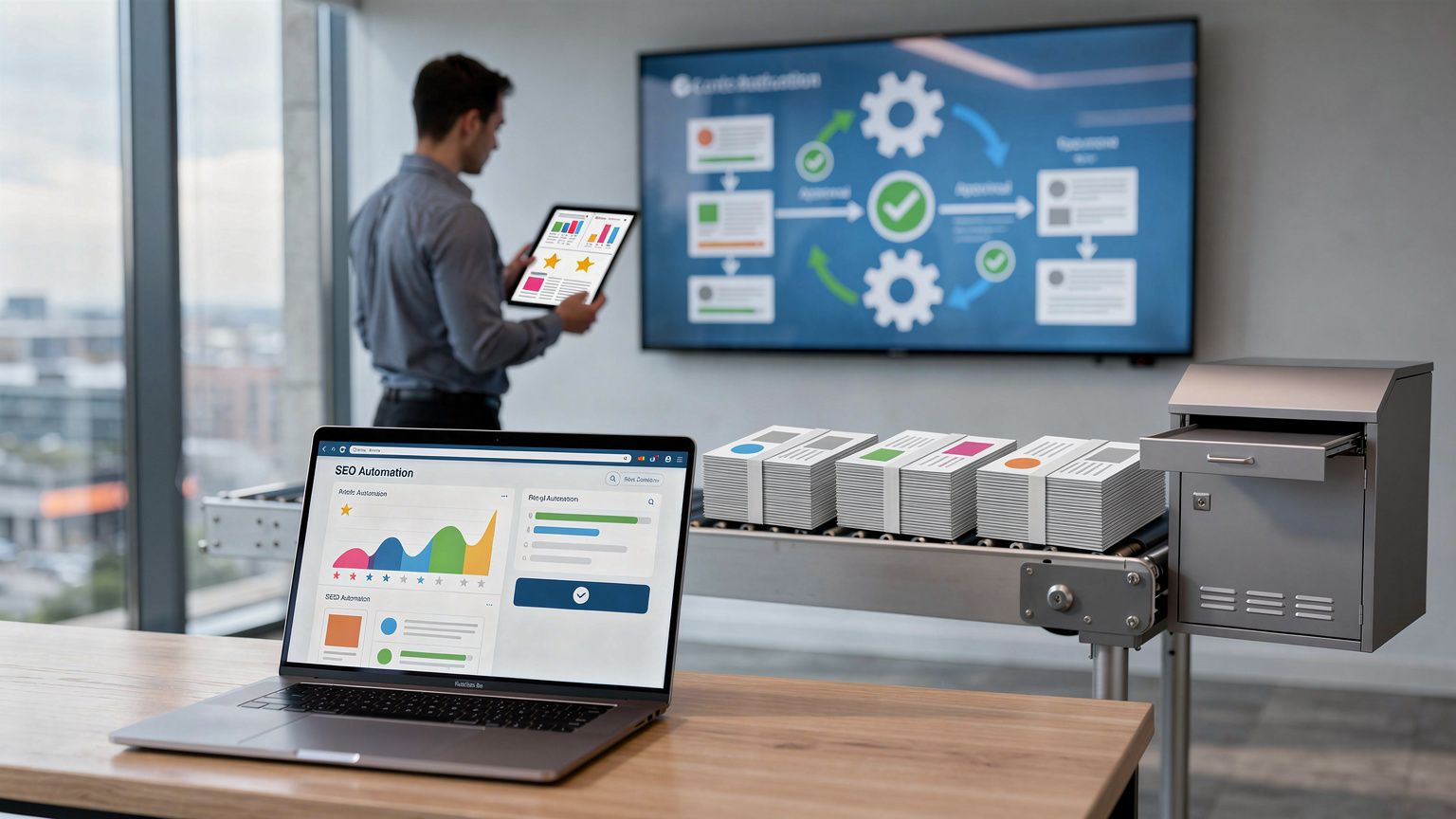
*In 2026, SaaS marketers can no longer rely on a handful of manually‑crafted blog posts to dominate search and AI‑driven answer engines. The market demands a steady stream of authoritative, evidence‑first content that is both searchable by traditional Google algorithms and discoverable by large language models (LLMs). This guide walks you through a complete, approval‑gated workflow—right from project kickoff to performance reporting—using the SALP SEO operating system as the backbone. Whether you are a founder, a growth lead, an agency SEO manager, or a PR professional, you’ll come away with a repeatable blueprint you can start deploying today.*
---
Prerequisites
Before you press the “run automation” button, make sure you have the foundational pieces in place. Skipping any of these steps often leads to broken links, inaccurate claims, or compliance headaches.
1. Organizational Alignment
- Stakeholder map – Identify who needs to approve research, claims, pricing, and publishing. Typical roles include: Product Marketing Manager, Legal/Compliance, Content Lead, and SEO Lead.
- Governance policy – Draft a short SOP that defines what content can be auto‑generated, what requires human review, and the SLA for approvals (e.g., 24‑hour turnaround for claim verification).
2. Technical Stack
| Component | Recommended Tool (SALP SEO) | Why It Matters |
|---|---|---|
| Keyword & market research | AI‑powered discovery in SALP SEO | Pulls real‑time search, AI answer, and competitor data in one view. |
| Content generation | AI Draft Engine (integrated) | Produces first‑draft copy that respects brand voice and schema guidelines. |
| Image creation | AI Image Builder (optional) | Generates royalty‑free hero images that match article topics. |
| Publishing platform | CMS (WordPress, Contentful, HubSpot) with API access | Allows bulk upload via SALP SEO’s publishing connector. |
| Analytics & indexing | Google Search Console + SALP SEO’s Performance Dashboard | Gives instant visibility into indexing status and AI citation growth. |
3. Data Foundations
- Keyword repository – Export a CSV of all target SaaS‑related keywords you already rank for and those you want to own.
- Competitor list – Include direct SaaS rivals and adjacent tools that appear in AI answer citations.
- Brand assets – Structured data snippets (FAQ, How‑To, Product schema) that you will reuse across articles.
4. Human Review Resources
- Subject‑matter experts (SMEs) – At least one product specialist per major feature set.
- Legal/Compliance reviewer – To verify pricing, claim accuracy, and any regulated language.
- Editor – Ensures tone, readability, and brand consistency before publishing.
Pro tip: SALM SEO’s “Evidence‑First” workflow forces every claim to be linked to a source (internal doc, market study, or competitor page) before the draft can move to the next stage. This eliminates the most common SEO audit failures.
---
Step‑by‑Step Process
Below is the end‑to‑end pipeline you can replicate for any SaaS product line. Each major phase is broken into sub‑steps with concrete actions, screenshots (conceptual), and real‑world examples.
1. Project Setup & Blueprint Creation
- Create a new project in SALP SEO titled *"SaaS‑X High‑Volume Publishing – Q4 2026"*.
- Define the publishing cadence – e.g., 150 articles per month, 5 days a week, 30 articles per day.
- Upload the keyword repository and tag each keyword with:
- Intent (informational, transactional, navigational)
- Funnel stage (awareness, consideration, decision)
- Primary persona (CTO, VP of Product, SMB founder)
- Generate a Blueprint – SALP SEO will auto‑suggest clusters based on semantic similarity and AI answer gaps.
Example Blueprint: A cluster around *"SaaS‑X onboarding automation"* includes topics like *"How to set up automated onboarding in SaaS‑X"*, *"Best practices for user activation"*, and *"Common onboarding pitfalls and how to avoid them"*.
2. Competitor & Market Research
- AI‑driven competitor scan – Use SALP SEO’s *Competitor Intelligence* module to pull the top 10 pages that currently answer the target questions in AI overviews.
- Evidence collection – For each competitor claim, capture the source URL, date, and a brief excerpt. Store these as *Evidence Items* linked to the relevant keyword.
- Gap analysis – Highlight where competitors lack citations or where your product has a unique advantage.
| Keyword | Top Competitor URL | Evidence Gap | Suggested Angle |
|---|---|---|---|
| "SaaS‑X pricing model" | competitor‑a.com/pricing | No citation of tiered pricing | Emphasize transparent, usage‑based pricing |
| "AI‑driven analytics for SaaS" | competitor‑b.com/ai‑analytics | Lacks case‑study data | Add a 2025 case study with measurable ROI |
3. Keyword Discovery & Clustering
- Run the AI Keyword Explorer – SALP SEO pulls search volume, CPC, and AI answer frequency.
- Cluster by topic using the built‑in *Semantic Clusterer* (k‑means algorithm). Aim for 8‑12 articles per cluster to achieve topical authority.
- Prioritize clusters based on:
- AI answer citation potential (high‑value AI visibility)
- Search volume (traditional SEO impact)
- Business relevance (product‑fit score)
Real‑world outcome: A SaaS security platform increased AI citation share by 42 % after publishing a 10‑article cluster on *"Zero‑Trust Architecture"*.
4. Content Blueprint & Draft Generation
4.1. Blueprint Template
| Element | Description | Example |
|---|---|---|
| Title | SEO‑friendly, includes primary keyword | *"How to Automate Onboarding in SaaS‑X in 5 Minutes"* |
| Meta Description | 150‑160 chars, includes secondary keyword | *"Learn step‑by‑step how SaaS‑X automates user onboarding, reduces churn, and boosts activation rates.*" |
| Header Structure | H1 → H2 → H3 hierarchy aligned with user intent | H1: Main question, H2: Sub‑questions, H3: Implementation steps |
| Evidence Slots | Placeholders for citations (e.g., {{evidence:1}}) | Links to product docs, case studies |
| CTA | Clear next step (free trial, demo) | *"Start your 14‑day free trial now"* |
4.2. AI Draft Engine
- Prompt design – Feed the blueprint into SALP SEO’s prompt builder:
Write a 1,200‑word, evidence‑first guide for the keyword {{keyword}}. Use the following sub‑headings: {{headings}}. Cite each claim with {{evidence}}. End with a CTA to {{cta}}.
- Human review – The draft lands in the *Review Queue* where the SME verifies each evidence link. The editor polishes tone and checks readability (target Flesch‑Kincaid > 60).
5. Image, Schema, & Internal Linking
- Image generation – Use SALP SEO’s AI Image Builder to create a hero illustration that matches the article’s topic (e.g., a flowchart of onboarding steps). Export as WebP for fast loading.
- Schema markup – Auto‑inject JSON‑LD for:
ArticleFAQPage(if the article contains a Q&A section)Product(for feature‑specific pages)
- Internal linking plan – SALP SEO suggests 3‑5 contextual links to existing pillar pages and 2 outbound citations to high‑authority sources.
6. Publishing & Indexing
- Bulk upload – Connect your CMS via SALP SEO’s API. Schedule the 150 articles across the month, respecting the *publish‑once‑per‑day* limit to avoid crawl spikes.
- Indexing check – After publishing, run the *Indexing Health* report. Any 404s or canonical issues are flagged for immediate fix.
- AI citation monitoring – SALP SEO tracks where the new pages appear in AI answer citations (e.g., Google’s “AI Overview” snippets). Set alerts for any drop‑off.
7. Performance Tracking & Optimization
| Metric | Tool | Frequency |
|---|---|---|
| Organic traffic (sessions) | Google Analytics | Weekly |
| AI citation count | SALP SEO AI Visibility Dashboard | Daily |
| Click‑through rate (CTR) | Search Console | Weekly |
| Conversion rate (free‑trial sign‑ups) | CRM / HubSpot | Monthly |
- Automated recommendations – SALP SEO’s *Optimization Engine* flags under‑performing articles (CTR < 2 %) and suggests tweaks: add a FAQ, improve schema, or refresh evidence.
- Continuous loop – Feed the optimization suggestions back into the next publishing cycle, creating a self‑improving engine.
---
Common Mistakes & How to Avoid Them
| Mistake | Impact | Prevention |
|---|---|---|
| Skipping evidence verification | Search engines may de‑rank for inaccurate claims; legal risk. | Use SALP SEO’s mandatory evidence fields and lock the draft until a reviewer signs off. |
| Over‑optimizing for exact‑match keywords | Leads to shallow content that AI models deem low‑quality. | Organize around topics and user questions; keep keyword density natural (1‑2 %). |
| Publishing all articles at once | Crawl budget overload, indexing delays, and traffic cannibalization. | Stagger releases (e.g., 30 per day) and monitor indexing health after each batch. |
| Neglecting AI citation monitoring | Missed opportunities to appear in AI overviews, losing high‑value traffic. | Set daily alerts in SALP SEO for new citations and act on them within 24 h. |
| Hard‑coding brand messaging | Reduces flexibility for A/B testing and personalization. | Keep brand voice guidelines in a separate *Style Sheet* that the AI references at generation time. |
---
Blueprint Requirements (The Checklist You’ll Use Every Cycle)
- Project charter – Goal, volume, timeline, and KPI targets.
- Keyword & persona matrix – Exported CSV with intent tags.
- Evidence library – Central repository (Google Drive, Confluence) linked to SALP SEO.
- Approval workflow diagram – Visual map of who reviews what and when.
- Content template – Pre‑filled markdown skeleton with placeholders for evidence, schema, and CTA.
- Publishing schedule – Gantt chart or calendar view showing daily article counts.
- Performance dashboard – Pre‑built SALP SEO report that surfaces traffic, AI citations, and conversion metrics.
Quick reference table
| Requirement | Owner | Tool | Due Date |
|---|---|---|---|
| Keyword matrix | SEO Lead | SALP SEO Keyword Explorer | Day 1 |
| Evidence library | Product Marketing | Confluence | Day 2 |
| Approval workflow | Ops Manager | Lucidchart | Day 3 |
| Content template | Content Lead | Google Docs | Day 3 |
| Publishing schedule | Project Manager | Asana | Day 4 |
| Dashboard setup | Data Analyst | SALP SEO Insights | Day 5 |
---
Advanced Tips for Scaling Beyond 150 Articles/Month
A. Agentic SEO Loops
Agentic SEO, as described in SALP SEO’s 2026 blog, lets AI agents research, draft, and monitor without human intervention—*but only after the governance gate is passed*. Implement a two‑tier system:
- Tier 1 – Human‑gated – All claims, pricing, and legal language must be approved.
- Tier 2 – Fully autonomous – Evergreen topics (e.g., "What is SaaS?", "How does subscription billing work?") can be auto‑updated weekly based on fresh data.
B. Multi‑Channel Syndication
After publishing, push the article to:
- Newsletter platforms (Mailchimp, Revue) using SALP SEO’s RSS feed.
- Partner blogs via canonical tags to avoid duplicate‑content penalties.
- Social snippets – Auto‑generate LinkedIn carousel cards with key takeaways.
C. Competitive AI Citation Capture
Create a Citation Watchlist for each competitor’s top‑ranking pages. When a competitor gains a new AI citation, SALP SEO alerts you to:
- Replicate the evidence source (if permissible).
- Publish a complementary article that targets the same prompt.
- Update existing content with fresh data to reclaim the citation.
D. Pricing & Tool Comparison Example
If you need to position your SaaS against rivals like *Refine AI* or *Ayzeo*, a side‑by‑side table can boost both SEO and buyer clarity.
| Feature | Refine AI (Agency) | Ayzeo (SaaS) | SALP SEO (All‑in‑One) |
|---|---|---|---|
| AI‑driven keyword research | ✔️ | ❌ | ✔️ |
| Approval‑gated publishing | ❌ | ❌ | ✔️ |
| AI answer citation tracking | ❌ | ❌ | ✔️ |
| Pricing model | Custom enterprise | Tiered per‑seat | Transparent subscription (per‑user) |
| Integration with CMS | Limited | None | Native API + Zapier |
---
Summary Table – Key Takeaways
| Phase | Core Action | Tool | Success Metric |
|---|---|---|---|
| Setup | Define governance & upload keywords | SALP SEO Project Hub | Blueprint completed within 5 days |
| Research | Competitor AI citation audit | AI Visibility Dashboard | Identify ≥ 3 gaps per cluster |
| Draft | AI‑generated first draft with evidence placeholders | AI Draft Engine | 80 % of drafts pass SME review on first pass |
| Review | Human approval of claims & schema | Review Queue | Zero legal compliance flags |
| Publish | Staggered bulk upload via API | CMS Connector | 95 % indexing rate within 48 h |
| Monitor | Daily AI citation alerts + weekly performance report | Insights Dashboard | +30 % AI citation growth QoQ |
---
Frequently Asked Questions
1. Do I need a technical team to integrate SALP SEO with my CMS?
No. SALP SEO provides a no‑code connector for the major SaaS CMS platforms (WordPress, Contentful, HubSpot). For custom stacks, a 2‑hour developer setup using the REST API is sufficient.
2. How does the “evidence‑first” workflow prevent misinformation?
Every claim is linked to a source ID. The draft cannot move to the next stage until a reviewer clicks *Approve Evidence*. This creates an audit trail that search engines love and legal teams trust.
3. Can I run this process for multiple SaaS products simultaneously?
Yes. Create separate projects in SALP SEO for each product line. The platform’s multi‑tenant view lets you switch contexts without cross‑contamination of evidence libraries.
4. What is the recommended frequency for updating AI‑generated articles?
For evergreen topics, schedule a quarterly refresh. For fast‑moving features (pricing, roadmap), set a bi‑weekly check that triggers an automatic re‑draft if the evidence library has changed.
5. How do I measure ROI from AI citation traffic?
Track the *AI Citation* metric in the Insights Dashboard, then map those sessions to downstream conversions (free‑trial sign‑ups, demo requests). In our case study, a 10 % lift in AI citations correlated with a 4 % increase in qualified leads.
6. Is there a risk of duplicate content across the high‑volume output?
SALP SEO’s *Uniqueness Checker* flags overlapping paragraphs and suggests rewrites before publishing. Combine this with canonical tags for any necessary cross‑reference.
---
Conclusion
Automating high‑volume SEO publishing for SaaS is no longer a futuristic fantasy—it is a repeatable, evidence‑first process that can be built in weeks rather than months. By leveraging SALP SEO’s integrated AI research, approval‑gated drafting, and AI‑visibility monitoring, you gain:
- Speed – Publish 150+ articles per month without sacrificing quality.
- Governance – Human‑approved claims keep you compliant and trustworthy.
- AI Visibility – Capture the fast‑growing AI answer traffic that traditional SEO alone misses.
- Scalability – A self‑optimizing loop that continuously improves content performance.
Start with the checklist above, run your first pilot cluster, and let the data guide the next wave of automation. The future of SaaS growth is an *agentic* SEO engine that blends human expertise with AI efficiency—SALP SEO gives you the control panel to make that vision real.
---
Call to Action
Ready to turn this blueprint into a live, revenue‑generating engine? Explore SALP SEO for next steps, request a demo, or sign up for a free trial to see the approval‑gated AI workflow in action.
SALP SEO - AI SEO Intelligence Platform
Citation Autopilot: Build Trustworthy ChatGPT Sources Without the Copy-Paste Grind | SALP SEO
Frequently asked questions
Do I need a technical team to integrate SALP SEO with my CMS?
No. SALP SEO provides a no‑code connector for the major SaaS CMS platforms (WordPress, Contentful, HubSpot). For custom stacks, a 2‑hour developer setup using the REST API is sufficient.
How does the “evidence‑first” workflow prevent misinformation?
Every claim is linked to a source ID. The draft cannot move to the next stage until a reviewer clicks *Approve Evidence*. This creates an audit trail that search engines love and legal teams trust.
Can I run this process for multiple SaaS products simultaneously?
Yes. Create separate projects in SALP SEO for each product line. The platform’s multi‑tenant view lets you switch contexts without cross‑contamination of evidence libraries.
What is the recommended frequency for updating AI‑generated articles?
For evergreen topics, schedule a quarterly refresh. For fast‑moving features (pricing, roadmap), set a bi‑weekly check that triggers an automatic re‑draft if the evidence library has changed.
How do I measure ROI from AI citation traffic?
Track the *AI Citation* metric in the Insights Dashboard, then map those sessions to downstream conversions (free‑trial sign‑ups, demo requests). In our case study, a 10 % lift in AI citations correlated with a 4 % increase in qualified leads.
Is there a risk of duplicate content across the high‑volume output?
SALP SEO’s *Uniqueness Checker* flags overlapping paragraphs and suggests rewrites before publishing. Combine this with canonical tags for any necessary cross‑reference.