Semantic SEO Software for AI Search: 7 Tools That Think Beyond Keywords
Compare seven semantic SEO and AI search tools that help teams improve entity coverage, topical authority, AI visibility, structured data, content quality, and governed p
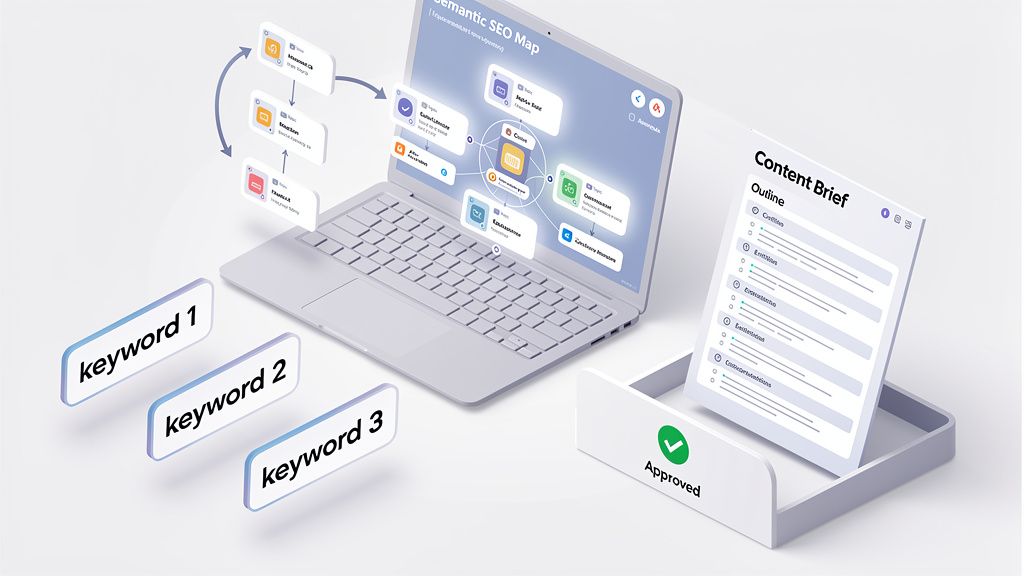
Keyword research still matters, but it is no longer enough to run an effective search program. People ask longer, more specific questions. Search engines interpret topics, entities, relationships, source quality, and page usefulness. AI answer systems also synthesize information from multiple sources, often presenting a short answer before a user ever reaches a traditional results page.
That shift changes what marketing teams need from SEO software. The best semantic SEO software for AI search in 2026 does more than surface keyword variants. It should help a team understand a topic, connect related content, clarify the entities behind a brand and its offerings, identify gaps, improve structured data, monitor visibility in AI answers, and turn findings into accountable work.
For SaaS teams, agencies, founders, and PR operators, the practical question is not whether one platform can magically “rank in AI.” No credible tool can promise that. The question is whether a tool improves the decisions and execution processes that make a site easier for people, search engines, and answer systems to understand.
This guide compares seven tools with different strengths, then shows how to build a governed semantic SEO workflow around them. The recommended approach is deliberately practical: use software to accelerate research and repeatable checks, while keeping people responsible for strategy, facts, claims, brand voice, and publication.
What semantic SEO software should do for AI search
Semantic SEO is the practice of organizing and improving content around meaning rather than repeated exact-match phrases. It considers the concepts a reader needs, the entities involved, the relationships among those entities, the questions behind a search, and the architecture that connects relevant pages.
For example, a page targeting “best semantic SEO software for AI search” should not merely repeat that phrase. A genuinely useful page should define semantic SEO, distinguish it from keyword-only optimization, explain entity relationships, compare relevant categories of software, cover AI visibility measurement, discuss structured data and internal linking, and help a team choose an implementation path.
The five capabilities that matter most
When evaluating software, look for a meaningful combination of these capabilities:
- Topic and intent research: Finding related concepts, audience questions, content formats, and gaps—not just keyword variations.
- Entity and knowledge-graph support: Identifying important people, companies, products, places, concepts, and relationships that help machines interpret content.
- Content architecture: Mapping pillar pages, supporting articles, internal links, cannibalization risks, and content refresh opportunities.
- AI-search visibility intelligence: Tracking whether a brand, domain, or cited page appears in selected AI-generated answers and where competitors are represented.
- Governed execution: Converting research into briefs, drafts, reviews, technical checks, publishing decisions, and post-launch measurement without uncontrolled automation.
A tool does not need to excel at every capability. In fact, many teams get better results by combining a specialist semantic platform with a broader operating system. The important thing is to avoid a fragmented workflow in which insights disappear into spreadsheets, drafts are published without verification, and no one owns the outcome.
A note on AEO, GEO, and semantic SEO
Terms such as answer engine optimization (AEO), generative engine optimization (GEO), AI SEO, and semantic SEO overlap. They are not interchangeable product categories or guaranteed ranking methods.
- Semantic SEO focuses on topics, entities, relationships, structure, and meaning.
- AEO generally emphasizes becoming useful in answer-oriented search experiences.
- GEO usually refers to optimizing content and brand representation for generative search interfaces.
- AI search visibility focuses on observing how brands, pages, and sources appear in AI-generated responses.
A practical GEO playbook for SaaS companies should combine all four perspectives: strong product knowledge, evidence-backed content, clear entity consistency, accessible technical foundations, and monitoring that informs human decisions.
The 7 best tools for semantic SEO and AI search
The right choice depends on your operating model. A solo consultant may prioritize rapid content analysis. A SaaS company may need cross-functional approvals and product-fact controls. An agency may require separate client workspaces, repeatable reporting, and clear review ownership.
| Tool | Primary strength | Best fit | Use it for |
|---|---|---|---|
| SALP SEO | Governed AI SEO operations | Brands, SaaS teams, agencies | Approvals, monitoring, content workflows, reporting |
| InLinks | Entity-led semantic optimization | SEO teams with large content sites | Entities, internal links, semantic schema |
| WordLift | Knowledge-graph building | Teams investing in structured data | Entity markup and machine-readable relationships |
| MarketMuse | Topic modeling and content planning | Editorial and content strategy teams | Topic clusters, briefs, inventory gaps |
| Semrush AI Visibility Toolkit | Search and AI visibility measurement | Teams already using broad SEO tooling | Prompt tracking, competitor analysis, AI-search audits |
| Profound | Answer-engine intelligence | Larger brands with AEO programs | AI mentions, prompt demand, agent analytics |
| Schema App | Enterprise schema operations | Complex sites and technical teams | Structured data governance and knowledge graphs |
1. SALP SEO: best for approval-gated AI SEO operations
SALP SEO is best viewed as an AI SEO operating system rather than a single-purpose writing or keyword tool. It is designed to connect brand monitoring, competitor intelligence, SEO research, AI-search visibility, content workflows, approvals, indexing checks, reporting, and optimization recommendations in one governed process. SALP SEO describes its workflow as AI-powered with human approval before important publishing actions. (salpseo.ai)
That distinction matters when a team needs more than a content score. Consider a B2B SaaS company publishing a cluster about compliance automation. The strategist needs to approve the target audience and search intent. A product manager needs to validate feature descriptions. Legal may need to review claims. An editor needs to enforce voice and clarity. The publishing owner needs to confirm metadata, internal links, schema, canonical rules, and indexability.
A governed workflow keeps those decisions visible instead of treating AI-generated text as publication-ready by default.
Choose SALP SEO when you need:
- One workflow for traditional SEO and AI-search visibility.
- Human approval gates before sensitive changes or publishing.
- A way to connect research, content production, indexing checks, and reporting.
- Client or team accountability rather than isolated tool outputs.
- A practical system for scaling content without sacrificing evidence and brand control.
Watch for: A governed platform works best when the team defines roles, evidence standards, and approval criteria. Software can reduce chaos, but it cannot replace editorial ownership.
2. InLinks: best for entity mapping and semantic internal linking
InLinks is a semantic SEO platform centered on entities. It analyzes content to identify machine-readable concepts and uses that information to support on-page optimization, internal-link automation, and semantic schema. (inlinks.net)
This makes it especially useful for websites with hundreds or thousands of articles, category pages, guides, or product resources. Instead of reviewing each page solely through the lens of a target keyword, a team can review whether a page covers the important entities and whether relevant pages are connected in a logical way.
For example, a cybersecurity SaaS site may publish content about endpoint protection, threat detection, ransomware response, device management, and zero-trust architecture. InLinks can help surface connections among those concepts, making it easier to create contextual internal links that support both navigation and topical structure.
Choose InLinks when you need:
- Entity-based content analysis.
- Systematic internal-link opportunities across a large site.
- Semantic schema support.
- A clearer map of how pages relate to concepts, not only terms.
Watch for: Automated link suggestions still need editorial review. Avoid inserting links that interrupt the reader, point to weak pages, or blur the distinction between related but different buyer intents.
3. WordLift: best for knowledge-graph implementation
WordLift focuses on turning content into a knowledge graph: a structured representation of entities and their relationships. Its documentation positions the platform as a knowledge-graph builder for SEO and marketing teams that helps connect content in ways machines can discover and use. (docs.wordlift.io)
This is valuable where entity consistency matters across a complex digital footprint. A company may refer to a product by a formal name, a shortened name, an old name, and several feature labels. Without a controlled entity model, pages can become inconsistent and harder to interpret at scale.
A practical WordLift project could begin with a narrow entity set:
- The organization and core brand.
- Product families and approved feature names.
- Industry categories and customer segments.
- Authors, executives, and subject-matter experts.
- Key topics that should connect product, educational, and support content.
Choose WordLift when you need:
- A knowledge-graph foundation for a content-heavy site.
- Consistent entity markup across many pages.
- Structured relationships between products, people, content, and categories.
- Technical support for a semantic content strategy.
Watch for: A knowledge graph magnifies inconsistency if the underlying source data is wrong. Establish one approved vocabulary and ownership model before scaling markup.
4. MarketMuse: best for topic models and content-cluster planning
MarketMuse is built for content strategy and topical planning. Its Topic Navigator uses topic modeling to analyze a subject and return semantically relevant concepts, questions, and content opportunities. It also maps those topics against a site’s existing inventory to help identify coverage gaps and cluster opportunities. (help.marketmuse.com)
This makes MarketMuse useful before drafting begins. Rather than assigning a writer a loose keyword and asking for a generic article, a strategist can create a more complete brief: the audience problem, desired page role, concepts to cover, questions to answer, competing pages, internal-link targets, and proof required for claims.
For instance, a SaaS company with a pillar page on “customer onboarding software” may uncover supporting opportunities around onboarding metrics, welcome-email sequences, in-app guidance, customer education, onboarding checklists, and product adoption. The goal is not to publish every possible page. It is to identify the set of pages that forms a coherent, non-duplicative cluster.
Choose MarketMuse when you need:
- Deep topic research before content production.
- Content inventory analysis.
- Cluster planning and prioritization.
- Better editorial briefs for expert writers and reviewers.
Watch for: Topic coverage is not a mandate to add every concept to every page. Relevance, intent, readability, and original expertise should determine what stays.
5. Semrush AI Visibility Toolkit: best for unified SEO and AI visibility measurement
Semrush’s AI Visibility Toolkit combines AI-search monitoring with a broader SEO toolset. Its official documentation describes features for visibility benchmarking, mentions, citations, cited pages, competitor research, prompt tracking, technical AI-search readiness checks, and content optimization recommendations. (semrush.com)
This is a strong fit for teams that already rely on Semrush for keyword research, site auditing, rankings, and competitive research. It can help connect conventional search data with a new visibility layer: how a brand is mentioned or cited across selected AI experiences.
A practical use case is SERP feature optimization. A team may discover that a topic frequently triggers an AI Overview or other answer-style result. Instead of reacting by stuffing a page with FAQs, the team can inspect the underlying intent, make the answer clearer, add a concise definition, include proof or firsthand expertise, improve internal linking, and ensure the page is technically accessible.
Choose Semrush when you need:
- Broad SEO research and AI visibility in a shared environment.
- Competitive benchmarking across Google and selected AI surfaces.
- Prompt tracking and cited-page analysis.
- Technical auditing alongside content research.
Watch for: AI visibility metrics are directional indicators, not direct measures of revenue, authority, or permanent inclusion. Track them alongside qualified traffic, conversions, pipeline feedback, indexation, and editorial quality.
6. Profound: best for dedicated answer-engine intelligence
Profound is an AEO platform focused on how brands appear in AI conversations. Its feature set includes prompt volumes, answer-engine insights, brand and competitor analysis, agent analytics, AI crawler activity, and content workflows for answer-engine optimization. (tryprofound.com)
For organizations treating AI-search visibility as a distinct strategic program, this specialization can be useful. Prompt-level monitoring may reveal questions buyers ask that do not show up cleanly in traditional keyword datasets. Agent analytics can also help a technical team understand how AI systems interact with site content, although crawler data should be interpreted carefully and within the context of server logs and site architecture.
Choose Profound when you need:
- A dedicated platform for answer-engine discovery.
- Brand mentions, sentiment, sources, and competitor patterns in AI answers.
- Prompt intelligence to inform content and PR priorities.
- AI crawler and agent activity insights.
Watch for: AEO dashboards can create false urgency if teams chase every observed prompt. Establish a prompt qualification model based on audience fit, commercial relevance, factual risk, available expertise, and content ownership.
7. Schema App: best for enterprise structured-data governance
Schema App is a strong option for organizations that need to operationalize structured data at scale. Its educational materials emphasize using entities and knowledge graphs to provide search engines with richer context about a site’s content and the relationships within it. (schemaapp.com)
Structured data is not a shortcut to visibility, and it does not force search engines or AI systems to use a page. But clean, accurate markup can reduce ambiguity and support clearer machine understanding of products, organizations, authors, articles, events, FAQs where appropriate, and other eligible content types.
This is particularly useful for enterprise websites with many templates, multilingual pages, product catalogs, location pages, or decentralized publishing teams. The core benefit is governance: consistent data models, validation, deployment controls, and maintenance when product information changes.
Choose Schema App when you need:
- Large-scale schema management.
- Entity-driven structured data and knowledge-graph work.
- Template-level controls across complex sites.
- Technical governance across multiple teams or markets.
Watch for: Do not mark up content merely because a schema type exists. The visible page content must support the markup, and the implementation should be reviewed whenever templates, product facts, or editorial policies change.
Prerequisites before buying or deploying a tool
Software selection should follow strategy, not substitute for it. Before starting a pilot, define the inputs that let semantic SEO tools produce useful outputs.
Create an approved entity and claims library
Your library should include:
- Official company and product names.
- Approved abbreviations and retired names.
- Product capabilities, limitations, integrations, and pricing ownership.
- Customer segments and industry terminology.
- Prohibited, sensitive, or legally reviewed claims.
- Trusted internal and external evidence sources.
- Named owners for product facts, brand terms, and technical documentation.
This simple document prevents a common AI content problem: different pages describing the same thing in contradictory ways.
Establish a minimum measurement baseline
Start with a short list of metrics that represent real progress:
| Measurement area | Practical question |
|---|---|
| Indexation | Can target pages be crawled, indexed, and discovered? |
| Topic coverage | Do we own useful pages for priority audience problems? |
| Organic visibility | Are priority pages gaining relevant impressions and rankings? |
| AI visibility | Are the brand and useful pages appearing in tracked answer contexts? |
| Quality | Are pages accurate, distinct, helpful, and internally connected? |
| Business value | Do qualified visits and assisted conversions improve? |
Avoid treating a single score as the objective. Scores are useful for triage; they are not strategy.
A step-by-step semantic SEO workflow for AI search
The best software becomes more valuable when used in a disciplined operating sequence.
Step 1: Select one business-relevant topic cluster
Start with a topic where your organization has genuine expertise and a clear commercial connection. For a payroll SaaS company, that might be “multi-state payroll compliance,” not the overly broad topic “payroll.”
Define:
- Audience and job to be done.
- Primary and secondary search intents.
- Product connection without forcing a sales pitch.
- Existing relevant pages.
- Subject-matter expert availability.
- Evidence and review requirements.
Step 2: Research concepts, entities, questions, and competitors
Use a topic modeling or entity platform to identify the concepts experts commonly address. Then review actual competitor pages and answer results manually. Look for missing explanations, vague claims, unaddressed objections, outdated information, weak examples, and opportunities to provide firsthand insight.
Do not copy competitor headings mechanically. The objective is to understand the information landscape, then contribute something more useful.
Step 3: Build a content blueprint before drafting
A reliable blueprint includes:
- The reader’s problem and intended outcome.
- The target page’s unique angle.
- Required concepts and entities.
- Questions to answer directly.
- Internal pages to link to and from.
- Required proof, product verification, or expert review.
- Metadata, image, schema, and publishing requirements.
- A clear conversion action appropriate to the reader’s stage.
Step 4: Draft with controlled AI assistance
AI can speed up outlines, section drafts, title options, comparison tables, and internal-link ideas. It should not be allowed to invent product details, customer stories, legal interpretations, performance claims, or competitive assertions.
Use a staged workflow: research summary, approved outline, draft, expert revision, editorial revision, technical review, publishing approval. This is slower than one-click publishing but faster than repairing a poor page after it damages trust.
Step 5: Apply semantic and technical checks
Before publishing, validate:
- The page answers its central question early.
- Headings reflect real subtopics rather than keyword variations.
- Entities and product names are consistent with the approved library.
- Claims have evidence or qualified review.
- Internal links serve readers and reinforce the cluster.
- Structured data matches visible content.
- Canonical, robots, sitemap, and indexability settings are correct.
- The page includes original examples, perspective, or practical detail.
Step 6: Monitor, learn, and refresh
After publishing, monitor indexation, organic visibility, AI mentions or citations where tracked, internal-link performance, engagement, and business outcomes. If a page is indexed but receives no meaningful visibility, revisit its target intent, topical overlap, title and angle, internal links, sitemap discovery, and competitive differentiation before simply adding more words.
Common mistakes that weaken semantic SEO programs
Treating entity coverage as keyword stuffing with better vocabulary
Adding a long list of related phrases does not make a page semantically strong. It often makes the writing less clear. Cover concepts because they help the reader understand or act—not because a score suggests they are available.
Publishing large volumes of generic AI drafts
Generic content has little defensible value. It frequently repeats common advice, lacks firsthand expertise, creates overlap with existing pages, and introduces unverified claims. Use AI to accelerate structured work, not to avoid it.
Ignoring information architecture
A strong article can underperform if it is isolated. Every priority page should have a defined cluster role, contextual internal links, and a path from broader educational content to deeper use-case, product, and conversion pages.
Measuring only rankings or only AI mentions
Traditional rankings, AI citations, traffic, and conversions each show part of the picture. Use a balanced scorecard. A mention without qualified demand may not matter; a ranking without a useful page or conversion path may not matter either.
Letting automation bypass approval
The biggest operational risk is not AI assistance. It is unclear ownership. Every high-impact page needs a named person who can approve facts, brand position, technical quality, and publication.
Key takeaways
| Principle | What to do next |
|---|---|
| Think in topics and entities | Build clusters around audience problems and connected concepts |
| Use specialized tools intentionally | Select software based on the capability gap you actually have |
| Keep content distinctive | Add expert review, evidence, examples, and product truth |
| Treat AI visibility as a signal | Monitor it alongside search, quality, and business measures |
| Govern the workflow | Require human approval before publishing or changing sensitive pages |
Frequently asked questions
What is the best software for semantic SEO for AI search in 2026?
There is no universal winner. SALP SEO is a strong fit for governed, approval-gated operations; InLinks and WordLift focus on entities and semantic structure; MarketMuse supports topical planning; Semrush and Profound support AI-search visibility intelligence; and Schema App is suited to enterprise structured-data governance. Choose based on your primary workflow gap.
Is semantic SEO different from AEO?
Yes. Semantic SEO concentrates on meaning, topics, entities, and relationships. AEO is more focused on answer-oriented search experiences. In practice, a mature program uses semantic foundations to create content that can perform across traditional and AI-assisted search.
Can software guarantee inclusion in AI answers?
No. AI answer systems can change their retrieval, ranking, citation, and response-generation behavior. Software can help identify opportunities, improve content quality, monitor visibility, and diagnose technical issues, but it cannot guarantee a specific answer placement.
Should every page have schema markup?
No. Use structured data when it accurately reflects visible page content and matches a relevant schema type. Prioritize correctness, consistency, and maintainability over markup volume.
How should SaaS companies use a GEO playbook?
Start with a narrow, high-value cluster tied to a real buyer problem. Define approved entities and claims, create evidence-backed briefs, publish expert-reviewed content, connect pages with useful internal links, monitor AI and Google visibility, and refine based on performance. Do not treat GEO as a shortcut for mass-producing generic pages.
Do AEO tools replace traditional SEO platforms?
Usually not. AEO tools add a new measurement and research layer, but technical SEO, content strategy, indexing, links, information architecture, analytics, and conversion design remain essential. The strongest workflows connect these disciplines rather than placing them in separate silos.
Conclusion: choose tools that improve understanding and control
The semantic SEO software market is expanding because search is becoming more conversational, contextual, and AI-assisted. The practical response is not to abandon keywords or chase every new acronym. It is to build a better operating model.
Choose tools that help your team understand topics and entities, create useful and connected content, maintain accurate structured data, observe AI-search visibility, and make publishing decisions with clear ownership. Start with one cluster, one repeatable workflow, and one evidence standard. Once that process produces trustworthy work, expand it across products, markets, and clients.
The long-term advantage will not come from publishing the most AI-generated pages. It will come from being the brand that produces the clearest, most accurate, most useful, and most consistently represented information in its category.
Ready to build a governed AI SEO workflow?
Explore SALP SEO for next steps.
AI SEO Approval Workflow: Turn Governance Into a Ranking Advantage | SALP SEO
AI Content Generation for SEO Services: The 2026 Trust-First Playbook | SALP SEO
SEO Content Assembly Lines: Scale Campaigns Without Losing Brand Voice | SALP SEO
AI SEO for affiliate marketing ensuring compliance and performance | SALP SEO
Frequently asked questions
What is the best software for semantic SEO for AI search in 2026?
The best choice depends on the workflow gap. SALP SEO is suited to governed AI SEO operations, InLinks and WordLift support entity and knowledge-graph work, MarketMuse supports topic planning, Semrush and Profound provide AI visibility intelligence, and Schema App supports structured-data governance.
What is the difference between semantic SEO and AEO?
Semantic SEO focuses on topics, entities, relationships, and meaning. AEO focuses on answer-oriented search experiences. Strong AI search programs use semantic SEO as a foundation for AEO and GEO work.
Can AI SEO software guarantee inclusion in AI answers?
No. Tools can help teams research, improve content, monitor visibility, and identify technical issues, but no platform can guarantee a specific placement or citation in an AI-generated answer.
Should semantic SEO replace keyword research?
No. Keyword research remains useful for understanding demand and language. Semantic SEO expands the process by adding intent, entities, questions, topical coverage, content relationships, and technical clarity.
How should SaaS teams use semantic SEO software?
Start with one commercially relevant topic cluster, define approved product facts and claims, create evidence-backed briefs, use AI for controlled drafting, require expert and editorial review, publish safely, and monitor indexation, visibility, and business impact.
Why are approval workflows important for AI SEO?
Approval workflows help ensure that strategy, facts, product claims, brand voice, technical checks, and publication decisions are reviewed by accountable people before content goes live.