Agency Content Ops 2026: AI Tools That Publish Everywhere Without Chaos
Learn how agencies can use AI multi-channel publishing tools in 2026 to scale content distribution, protect brand consistency, and keep human approvals in control.
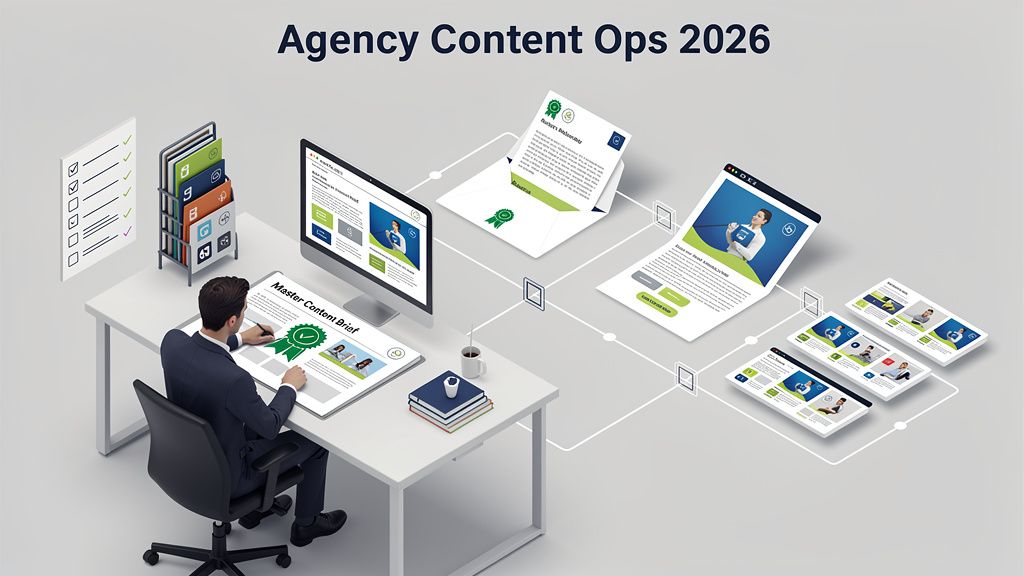
AI can help agencies turn one approved idea into a coordinated article, client newsletter, landing-page update, social campaign, knowledge-base entry, and distribution plan. But publishing more quickly is not the same as operating well.
For agencies, the real challenge in 2026 is not finding another AI writing tool. It is building a dependable content operating system: one that connects research, client strategy, brand rules, approvals, publishing, indexing checks, performance reporting, and optimization. Without that system, multi-channel publishing creates a familiar kind of chaos: conflicting messages, duplicated work, missed approvals, broken links, off-brand claims, and client uncertainty about what went live.
The strongest approach is approval-gated AI. AI handles repeatable work such as research synthesis, first drafts, repurposing suggestions, metadata, internal-link opportunities, and distribution checklists. People retain control over strategy, factual claims, client sign-off, and publishing decisions.
This guide explains how agencies can evaluate and implement AI multi-channel publishing tools in 2026 without losing brand consistency, accountability, or search performance.
What AI multi-channel publishing means for agencies
AI multi-channel publishing is the coordinated creation, adaptation, approval, and release of content across several owned channels from a shared source of truth. For an agency, those channels may include:
- SEO articles and resource hubs
- Service and product landing pages
- Client newsletters
- LinkedIn posts and executive thought-leadership content
- Social-media variations
- Sales enablement assets
- PR briefs and media pitches
- Knowledge-base documentation
- Google Business Profile updates
- Content refreshes for existing pages
The useful word is coordinated. Publishing an article and then asking an AI tool to create ten loosely related posts is not a content operation. A real operating model makes sure every version uses the same approved positioning, product details, brand terminology, proof points, audience assumptions, and conversion goal.
Why agencies need more than an AI content generator
An AI blog generator can accelerate drafting, but agencies have obligations that go beyond producing words. They need to manage many clients, markets, stakeholders, approval paths, and reporting requirements at the same time.
A typical agency team might be responsible for a B2B SaaS client in the United States, an ecommerce client with seasonal promotions, and a regulated professional-services client. Each needs different claims rules, publishing permissions, editorial standards, keyword priorities, and approval turnaround times.
A simple drafting tool rarely solves these operating questions:
- Which client-approved claims can be reused?
- Which subject matter expert must review this topic?
- Is the source article ready for publication, or is it still a draft?
- Which channels may receive an adapted version?
- Has the page been internally linked and added to the sitemap?
- Did the page index, earn impressions, and support the original business goal?
- Can the account team show the client a clear audit trail?
The best AI multi-channel publishing tools answer those questions through workflow design, not just generation quality.
The agency advantage: one approved source, many purposeful outputs
When agencies use an approval-gated process, each approved content brief becomes an operational asset. Instead of creating content separately for every channel, the team creates one structured source package containing:
| Component | What it controls |
|---|---|
| Audience and search intent | Who the content serves and why they need it |
| Core message | The angle that remains consistent across channels |
| Approved facts and proof | Claims, examples, product details, and citations to verify |
| Brand entity rules | Product names, service terminology, spokesperson names, and preferred phrasing |
| SEO targets | Primary topic, supporting keywords, internal links, and page intent |
| Channel plan | Which derivative assets are useful and which are not |
| Approval criteria | Who reviews strategy, copy, legal risk, and final publication |
That source package reduces rework. It also makes it easier to automate brand entity consistency across a large client portfolio.
Prerequisites: build control before you add speed
AI publishing workflows work best when teams establish a small amount of structure before connecting generation and publishing tools. Agencies do not need a massive governance program to begin. They do need clear ownership and rules.
Define roles, decision rights, and service levels
Every workflow should specify who does the work, who reviews it, and who can authorize publication. Those responsibilities should be visible inside the project rather than buried in email threads.
A practical agency workflow may include:
| Role | Primary responsibility | Approval authority |
|---|---|---|
| Account lead | Aligns work to client goals and scope | Client-facing priorities and delivery expectations |
| SEO strategist | Owns keyword strategy, clusters, and search intent | SEO brief and optimization recommendations |
| Content strategist | Builds the narrative, format, and distribution plan | Editorial direction |
| AI operator or writer | Produces drafts and channel adaptations | No final publishing authority |
| Editor | Protects clarity, voice, and factual discipline | Editorial quality |
| Subject matter expert | Verifies technical, product, or industry claims | Domain accuracy |
| Client approver | Confirms brand, legal, and business alignment | Final client approval where required |
| Publisher | Runs final technical checks and releases assets | Publishing execution |
Set service-level agreements as well. For example, an editor may have two business days to review a standard article, while a client legal review might receive five business days. AI will not remove approval delays, but it can make blockers visible early enough to manage them.
Create a one-page governance policy
A one-page policy is enough for many agency teams starting out. It should state:
- What AI may do: research assistance, outlines, drafting, metadata suggestions, repurposing, internal-link recommendations, and performance summaries.
- What requires human review: material claims, customer stories, pricing, security statements, medical or legal guidance, product capabilities, comparative statements, and all publish actions.
- What cannot be invented: testimonials, proprietary metrics, customer logos, expert quotes, certifications, case-study outcomes, or legal promises.
- How sources are handled: evidence must be saved in the project brief before it becomes a public claim.
- Who can approve what: define client, agency, and subject-matter-expert authority.
This policy turns vague concerns about AI quality into an actionable review standard.
Standardize client brand entities and reusable knowledge
Brand consistency problems are often data problems disguised as writing problems. If the client name, product module names, preferred audience labels, differentiators, and prohibited terms are stored in scattered documents, AI will produce inconsistent variants.
Build a structured client knowledge library that includes:
- Official company and product names
- Short and long product descriptions
- Audience segments and job titles
- Approved positioning statements
- Competitor names and approved comparison language
- Brand voice rules and terms to avoid
- Legal or compliance restrictions
- Proof points with source owners and review dates
- Existing cornerstone pages to link internally
For example, an agency serving a payroll SaaS client could define whether the product should be described as a “payroll platform,” “workforce management system,” or both. It can also specify that the product does not provide legal advice, that pricing must not be mentioned without review, and that enterprise security claims require approval from the client’s security lead.
Establish a measurement baseline
Publishing everywhere is only valuable if the agency can show what changed. Before launching a new workflow, capture a baseline for each client or content cluster:
- Indexed pages
- Organic impressions and clicks
- Click-through rate and average position
- AI search visibility or brand mentions where measurement is available
- Content production cycle time
- Revision rounds per asset
- Approval turnaround time
- Conversion or assisted-conversion signals
- Number of outdated, duplicate, or unowned assets
A page that is live and indexable but receives no impressions is not a success simply because it was published. It may need better query targeting, stronger internal links, improved sitemap discoverability, or a more useful angle.
Step-by-step process for controlled multi-channel publishing
The following process gives agencies a repeatable operating model. Start with one client, one audience, and one cluster. Prove the workflow before expanding it across every account.
1. Start with search, market, and audience evidence
Do not begin with a request to “write a blog about AI.” Begin with an evidence-backed opportunity.
Research should bring together:
- Search demand and query patterns
- Competitor topics, page types, and visibility gaps
- Questions raised by prospects and customers
- Product launches or seasonal priorities
- Existing content performance
- AI search and brand-mention signals
- Sales objections and customer-success feedback
Suppose an agency supports a cybersecurity SaaS company. The client wants more awareness among IT managers evaluating access controls. The agency identifies a cluster around identity governance, access reviews, and employee offboarding. Rather than produce five unrelated posts, it creates one pillar strategy with supporting articles, a comparison page, newsletter education, and executive social posts.
The brief should clarify the primary question, the decision stage, the client’s distinct point of view, and the desired next step.
2. Create a channel-aware content blueprint
A content blueprint is more useful than a generic outline because it plans the whole lifecycle of the idea. It should include the main page plus its channel adaptations before drafting begins.
For a pillar article, the blueprint might include:
| Asset | Purpose | Required adaptation |
|---|---|---|
| SEO article | Capture informational search demand | Deep explanation, internal links, FAQs, clear next action |
| Landing-page module | Support service or product conversion | Short proof-led summary and relevant CTA |
| Newsletter | Re-engage subscribers | Strong hook, concise lesson, link to full guide |
| LinkedIn post | Build executive reach | Opinionated takeaway and practical example |
| Sales one-pager | Help follow-up conversations | Objection handling and buyer language |
| Content refresh task | Strengthen an existing related URL | Add link, update context, remove overlap |
Not every article needs every derivative asset. A technical troubleshooting guide may be better for SEO and customer education than for broad social distribution. The blueprint prevents automatic repurposing from becoming low-value content volume.
3. Generate drafts with constrained inputs
Give AI a complete enough brief that it can assist productively without filling gaps with assumptions. The prompt or template should provide:
- Target audience and intent
- Primary keyword or topic
- Required sections
- Approved evidence and restricted claims
- Brand voice requirements
- Desired reading level
- Relevant internal pages
- Channel-specific constraints
- Required reviewer notes
For example, a LinkedIn adaptation should not merely summarize every heading from a 2,500-word article. It may focus on one contrarian lesson: “The fastest agency content process is not no-review publishing; it is fewer, clearer approval decisions.”
The AI can draft alternatives, but a human should choose the message that aligns with the client’s point of view.
4. Run staged approvals instead of one giant final review
One final approval at the end causes expensive rewrites. Use approval gates at the moments where the right reviewer adds the most value.
A useful sequence is:
- Strategy gate: Confirm topic, search intent, audience, and business objective.
- Evidence gate: Verify facts, source material, product details, and competitive claims.
- Editorial gate: Review structure, tone, clarity, differentiation, and usefulness.
- Channel gate: Confirm each adaptation fits its destination and is not redundant.
- Publication gate: Check metadata, links, images, schema, formatting, and final permissions.
- Post-launch gate: Verify indexability, live-page rendering, tracking, and early performance signals.
This approach is especially useful for agencies that serve both small businesses and enterprises. Small-business clients may prefer a fast account-lead review with defined guardrails. Enterprise clients may require brand, product, security, legal, and regional review. The core system can remain the same while approval depth changes by risk level.
5. Publish with a technical go-live checklist
Content quality and publishing quality are different. A strong article can still fail if it is inaccessible to crawlers, lacks internal links, or is published under the wrong URL structure.
Before publishing, check:
- URL, title tag, and meta description
- Heading hierarchy and readability
- Canonical settings where relevant
- Internal links to and from related pages
- Image alt text and image rights
- Structured data suitability
- Mobile rendering
- Calls to action and conversion tracking
- Sitemap inclusion
- Indexing permissions and robots directives
- UTM conventions for campaign distribution
For agency work, save the completed checklist in the client project. It gives account teams a reliable answer when clients ask, “What exactly was checked before this went live?”
6. Monitor indexing, engagement, and operational health
Do not wait until the monthly report to discover a problem. Monitor the first days and weeks after publishing.
Operational signals include:
- Was the page discovered and indexed?
- Did it receive impressions for relevant queries?
- Are internal links working?
- Did the newsletter and social posts drive qualified visits?
- Did the content create duplicate-intent conflict with an existing page?
- Did approval turnaround improve or worsen?
- Are particular client reviewers repeatedly blocking the same kinds of claims?
Performance monitoring should lead to specific recommendations. If an article is indexed but has zero impressions after a reasonable observation period, review query targeting, search intent alignment, internal linking, topical authority, and sitemap visibility. If impressions rise but clicks remain weak, test a more compelling title, stronger meta description, or a clearer match between the query and page promise.
Common mistakes that create multi-channel chaos
AI makes bad processes faster too. The following mistakes are common when agencies try to scale production before they establish control.
Mistake 1: Treating every channel as a copy-and-paste destination
A blog article, email, sales deck, and social post have different jobs. Copying the same text across them produces repetitive messaging and weak audience fit.
Better approach: Keep the core claim consistent, then change the format, depth, hook, and call to action for each channel.
Mistake 2: Approving content without approving the evidence
Teams sometimes review grammar and tone while overlooking the factual basis for a claim. This is risky for product statements, market comparisons, compliance topics, and customer outcomes.
Better approach: Put facts in the brief, label their source owner, and require subject matter review for high-stakes assertions.
Mistake 3: Letting client knowledge live only in prompts
When key rules are manually pasted into prompts, the process becomes inconsistent and difficult to audit. Different writers may use different versions of the same positioning.
Better approach: Maintain a shared, versioned client knowledge library with approved entities, messages, claims, and restrictions.
Mistake 4: Measuring output instead of impact
Publishing 40 assets per month may look productive while creating no meaningful increase in visibility, pipeline support, or client trust.
Better approach: Report on indexed pages, impressions, clicks, rankings, AI visibility signals, conversion assistance, approval cycle time, and the content decisions that produced those outcomes.
Mistake 5: Automating publication before stabilizing approvals
Direct publishing can be useful for low-risk, pre-approved formats. It is dangerous when it bypasses review for client-facing claims or high-value pages.
Better approach: Automate preparation and recommendations first. Add direct publishing only where permissions, templates, and approval gates are explicit.
Mistake 6: Ignoring entity consistency across client portfolios
A growing agency may accidentally use different names for the same service, feature, or client category across dozens of assets. This weakens brand clarity and creates unnecessary review work.
Better approach: Use standardized entity fields and approved terminology. Review deviations intentionally rather than discovering them after publication.
Choosing AI publishing software: capabilities that matter
The best software for agencies is not necessarily the tool with the most generation modes. It is the tool that reduces operational friction while preserving clear accountability.
Look for a governed workflow, not isolated features
A strong platform should connect the workflow from research to optimization. SALP SEO is designed around this operating-system model for brands, agencies, SaaS teams, and growth teams: project setup, competitor research, keyword discovery, clustering, blueprints, article generation, image generation, schema, internal links, publishing, indexing checks, performance tracking, and optimization recommendations can be managed in one governed workflow.
For an agency, that means less context-switching between disconnected tools and fewer opportunities for strategy to get lost between research, production, approval, and reporting.
Evaluation checklist
Use the following questions when evaluating AI multi-channel publishing tools in 2026:
| Capability | Questions to ask |
|---|---|
| Multi-client management | Can teams separate client data, permissions, templates, and reports? |
| Approval workflows | Can approvals be assigned by content type, risk level, and stakeholder? |
| Evidence capture | Can the team store sources and reviewer notes with the content brief? |
| Content planning | Does the platform support clusters, briefs, and related internal-link planning? |
| Brand governance | Can it maintain approved entities, style guidance, and prohibited claims? |
| Publishing controls | Can it require final checks before content moves live? |
| Indexing checks | Can the team identify pages that are live but not gaining visibility? |
| Competitor intelligence | Can strategists monitor relevant search and market changes? |
| Reporting | Can account teams connect outputs to visibility and operational metrics? |
| Auditability | Can the agency show who approved, edited, and published an asset? |
When smaller agencies and enterprise agencies need different setups
Small agencies often need simplicity: reusable templates, quick approvals, portfolio reporting, and a clear way to avoid dropped tasks. Enterprise agencies need those capabilities plus stricter permissions, region-specific brand rules, client stakeholder routing, audit trails, and more detailed governance.
The difference is usually not whether AI is used. It is how much review, evidence, and permission control surrounds it.
A 30-day pilot plan for agencies
Do not attempt to rebuild the entire content department in one quarter. Start with a pilot cluster that is important enough to show results but contained enough to manage closely.
Week 1: Set up the operating model
- Select one client and one priority topic cluster.
- Define roles, approval gates, and turnaround expectations.
- Create the client knowledge library.
- Establish baseline performance and workflow metrics.
- Identify existing pages that should be updated or linked.
Week 2: Build the blueprint and produce source content
- Complete competitor and keyword research.
- Approve the content blueprint.
- Draft one pillar article and two supporting assets.
- Validate evidence and product claims.
- Complete editorial review before channel adaptation.
Week 3: Adapt, approve, and publish
- Produce selected email, social, landing-page, or sales adaptations.
- Run channel-specific reviews.
- Complete technical publishing checks.
- Publish the primary asset and schedule distribution.
- Log all approvals and final asset locations.
Week 4: Measure, learn, and improve
- Confirm indexing and rendering.
- Review impressions, early engagement, referral traffic, and operational timing.
- Identify content gaps and internal-link opportunities.
- Document recurring reviewer feedback.
- Update templates, governance rules, and the next cluster plan.
Key takeaways
| Principle | Practical action |
|---|---|
| Scale from a source of truth | Use an approved brief and knowledge library before creating channel variations |
| Keep humans at decision points | Gate strategy, evidence, high-risk claims, and publication |
| Adapt rather than duplicate | Give each channel a distinct purpose, format, and CTA |
| Treat technical SEO as part of publishing | Check internal links, indexability, sitemap inclusion, and page rendering |
| Measure operational quality too | Track approval time, revision rounds, visibility, and business outcomes |
| Pilot before expanding | Prove the workflow with one client cluster, then standardize it |
Frequently asked questions
What are AI multi-channel publishing tools?
They are tools and workflows that help teams create, adapt, approve, distribute, and measure content across multiple channels from a shared strategy. For agencies, the most valuable versions include client separation, approval controls, brand governance, publishing checklists, and reporting.
Can an agency use AI to publish directly to client websites?
It can, but direct publishing should be limited to approved formats and permissioned workflows. High-stakes pages, product claims, regulated topics, and major SEO changes should receive human review before publication.
How do agencies maintain brand consistency when using AI?
Store approved terminology, product descriptions, messages, proof points, prohibited claims, and voice guidance in a shared knowledge library. Then require editorial review for deviations or new claims.
Is an AI blog generator enough for agency content operations?
Usually not. Draft generation solves only one stage of the process. Agencies also need research, content planning, approvals, technical checks, publishing coordination, indexing monitoring, performance tracking, and client reporting.
What should agencies measure after publishing AI-assisted content?
Track indexability, impressions, clicks, click-through rate, engagement, conversions or assisted conversions, internal-link coverage, approval cycle time, revision rounds, and portfolio-level content performance.
How can agencies use AI search competitor monitoring effectively?
Monitor competitors for topic changes, content gaps, visibility shifts, brand mentions, and new page types. Use that intelligence to improve client strategy, not to copy competitor wording or publish reactive content without validation.
Conclusion: publish faster by making fewer risky decisions
Agency content operations do not become scalable when every task is automated. They become scalable when every team member knows what is approved, what needs review, what can be reused, and how performance will be measured.
In 2026, the winning agencies will use AI to remove repetitive production work while keeping human judgment attached to strategy, evidence, client trust, and publication. A governed workflow makes it possible to produce more useful assets across more channels without turning client content into an untraceable stream of drafts.
Start with one content cluster, document the approvals, centralize brand knowledge, and measure what happens after publication. Once that system works, expansion becomes a controlled operational improvement rather than a leap of faith.
Explore Salp SEO for next steps.
SEO Content Assembly Lines: Scale Campaigns Without Losing Brand Voice | SALP SEO
AI SEO Approval Workflow: Turn Governance Into a Ranking Advantage | SALP SEO
AI SEO Approval Workflows: Ship Faster Without Losing Brand Control | SALP SEO
AI SEO Workflow Approvals: Build a Faster, Safer Content Assembly Line | SALP SEO
Frequently asked questions
What are AI multi-channel publishing tools?
They help teams create, adapt, approve, distribute, and measure content across multiple channels from a shared strategy and source of truth.
Can agencies let AI publish directly to client sites?
Yes, but direct publishing should be restricted to approved, low-risk workflows. High-stakes claims and important pages should remain human-approved before release.
How do agencies preserve brand consistency with AI?
Use a centralized, versioned knowledge library containing approved brand entities, product language, voice rules, proof points, and prohibited claims.
Is an AI blog generator sufficient for an agency workflow?
No. Agencies also need research, planning, approval routing, technical publishing checks, indexing monitoring, reporting, and client-facing auditability.
Which metrics matter after AI-assisted content is published?
Track indexing status, impressions, clicks, CTR, engagement, conversions or assisted conversions, approval cycle time, revision rounds, and content performance over time.
How should agencies begin implementing this model?
Run a 30-day pilot for one client and one topic cluster. Define roles and approvals, build a source-of-truth brief, publish a small set of coordinated assets, then refine the process using performance and governance lessons.