AI Mode Visibility Software: The New Search Share-of-Voice Scorecard
Learn how to approach AI mode visibility software with practical steps, examples, risks, FAQs, and next actions.
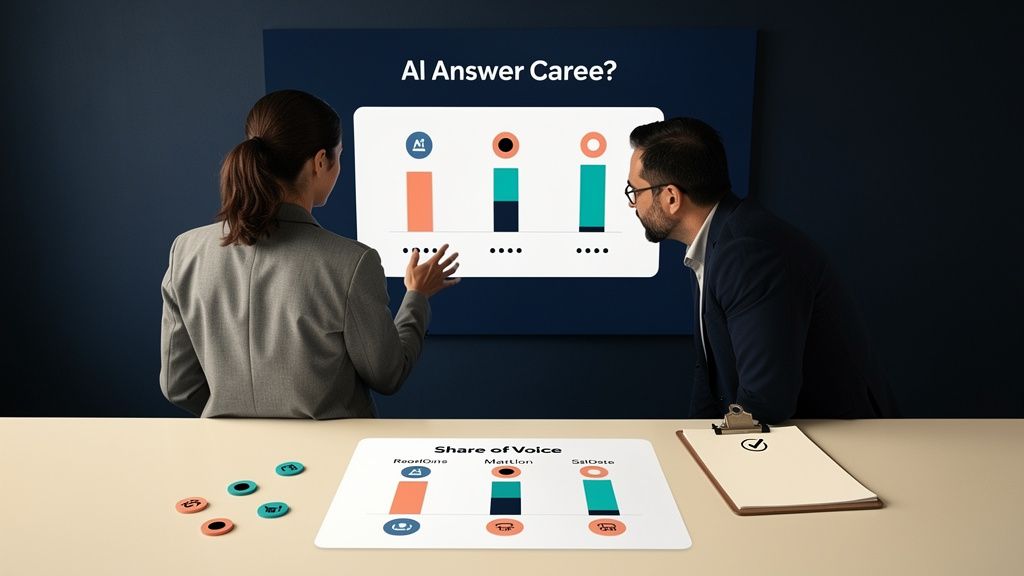
Search visibility is no longer limited to where a page ranks in a list of blue links. Buyers increasingly ask AI-powered search experiences to compare vendors, explain categories, shortlist products, troubleshoot problems, and recommend next steps. In this environment, a brand can have strong conventional rankings yet be absent when an AI system summarizes the market.
That is why AI mode visibility software matters. It gives marketing, SEO, product, content, and PR teams a structured way to understand whether their brand appears in AI-generated answers, how it is described, which competitors are mentioned instead, and what evidence may be influencing those outcomes.
The objective is not simply to collect mentions. It is to create a reliable share-of-voice scorecard for the answer layer: a governed view of brand presence across important prompts, topics, audiences, competitors, and markets. The best programs connect this visibility data to practical actions, including content improvements, entity consistency, technical SEO, competitor research, expert review, approval workflows, and performance tracking.
For teams operating at scale, the process needs controls. A weak workflow can lead to unverified conclusions, irrelevant content production, inconsistent messaging, or reactive changes made without proper review. A governed AI SEO operating system helps teams move quickly while ensuring that high-impact recommendations, product claims, and publishing actions receive appropriate human approval.
What AI mode visibility software measures
AI mode visibility software is a category of search-intelligence tooling designed to monitor how brands, products, sources, and competitors appear in AI-powered search experiences. Rather than treating rankings as the sole measure of success, it evaluates presence within generated answers and the surrounding discovery journey.
A useful platform does more than answer the question, “Did our brand appear?” It helps teams understand the quality and context of that appearance.
The core components of an AI search share-of-voice scorecard
A practical scorecard should include several dimensions. Each one answers a different business question.
| Scorecard dimension | What it answers | Why it matters |
|---|---|---|
| Brand mention presence | Does the brand appear for priority prompts? | Establishes baseline visibility in AI answers. |
| Mention position and prominence | Is the brand introduced early, listed as an option, or buried in passing? | Prominent mentions are more likely to shape consideration. |
| Sentiment and framing | How is the brand described? | Reveals whether AI answers reinforce or weaken positioning. |
| Competitor share of voice | Which competitors appear more often for the same topics? | Identifies gaps and category-level threats. |
| Source and citation patterns | What types of sources appear to support the answer? | Guides evidence-building and content strategy. |
| Topic and prompt coverage | Which use cases, questions, and category terms trigger mentions? | Connects visibility to customer intent. |
| Change over time | Is presence improving, declining, or becoming less consistent? | Helps teams prioritize investigation and action. |
The term “share of voice” should be used carefully. It is not a universal truth about every AI answer a person might receive. Outputs can vary based on query wording, geography, language, personalization, product changes, and the source systems used by a search experience. Instead, treat the score as a controlled measurement across a documented prompt set.
That distinction is important. A trustworthy scorecard does not claim that a brand owns a fixed percentage of all AI search. It shows the brand’s observed presence within a repeatable set of strategically important questions.
Why traditional rank tracking is no longer enough
Traditional rank tracking remains valuable. It can show how pages perform in conventional organic results and help teams identify technical, content, and competitive issues. But it does not fully explain how a buyer experiences an AI-generated answer.
Consider a SaaS company that ranks for a category page and several integration articles. A buyer may still ask an AI search system, “What are the best platforms for governed AI SEO workflows?” If the answer names three competitors, describes their strengths, and never mentions the SaaS company, conventional rankings alone do not reveal the full visibility gap.
AI mode visibility software adds the missing layer. It helps teams monitor whether the brand is:
- Included in category comparisons.
- Associated with its intended capabilities.
- Recommended for the right customer profile.
- Mentioned in relevant use-case discussions.
- Represented accurately when product features are summarized.
- Competing effectively against other brands in generated answers.
This does not replace SEO fundamentals. It makes those fundamentals more connected to how modern search discovery actually works.
Prerequisites for a reliable AI visibility program
Before monitoring hundreds of prompts, establish the operating foundations that make the data useful. The goal is to avoid a dashboard full of observations with no clear owner, context, or next action.
Define the business questions first
Start with the decisions the scorecard must support. For example, a marketing team may need to know whether its brand is becoming visible in high-intent category questions. A product marketing team may want to evaluate whether AI answers understand a new capability. An agency may need a client-ready process for comparing visibility across markets.
Useful business questions include:
- Are we mentioned when prospective customers ask category and solution-comparison questions?
- Do AI answers describe our product using approved positioning and accurate capabilities?
- Which competitors are consistently included in the same answers?
- Which topics create the biggest gap between our conventional search strength and AI visibility?
- Are changes in visibility connected to new content, product launches, PR activity, or technical issues?
Without these questions, teams often over-monitor generic prompts that are interesting but do not support meaningful commercial decisions.
Build a governed prompt library
Your prompt library is the measurement framework behind the scorecard. It should be a shared, version-controlled collection of queries that represent real customer needs and important market conversations.
Organize prompts by intent instead of creating one unstructured list. Common groups include:
- Category discovery: “What is AI SEO software?”
- Problem awareness: “How can a SaaS company monitor AI search visibility?”
- Solution evaluation: “What tools help marketing teams track brand mentions in AI search?”
- Comparison: “Best platforms for AI SEO intelligence and approvals.”
- Use case: “How can an agency manage AI search visibility for multiple clients?”
- Implementation: “How do you build an approval workflow for AI-generated SEO content?”
- Brand-specific: “What does SALP SEO help teams do?”
For each prompt, document the audience, funnel stage, market, language, owner, intended review cadence, and reason it matters. This turns prompt monitoring into a repeatable research asset rather than an ad hoc experiment.
Establish entity and messaging standards
AI systems need consistent, accessible signals to understand a brand. Before reacting to visibility gaps, make sure your own public materials clearly explain who you are, what you offer, who you serve, and how your solution differs.
For example, SALP SEO can consistently describe itself as an AI SEO operating system for brands, agencies, SaaS teams, and growth teams. Its messaging can reinforce that it brings together AI visibility monitoring, competitor intelligence, research, content operations, approvals, publishing support, indexing checks, performance tracking, and optimization recommendations in one governed workflow.
Create an internal reference page with approved language for:
- Company name and product naming.
- Category definition.
- Target customers and markets.
- Core capabilities.
- Differentiators.
- Product claims requiring legal, product, or executive review.
- Competitor comparison rules.
- Sources that can be used to substantiate claims.
Consistency does not mean repeating the same sentence everywhere. It means ensuring that all accurate variations lead back to the same core entity and positioning.
Step-by-step process for building the scorecard
A good AI mode visibility program is iterative. Begin with a controlled pilot, learn from the signal, and expand only once the team has a dependable process for interpretation and action.
Step 1: Select a focused pilot cluster
Choose one topic cluster that connects directly to business priorities. For a B2B SaaS platform, this could be “AI SEO governance.” For an agency, it may be “AI search visibility reporting.” For a product-led company, it might be a feature or integration category.
Avoid starting with every possible keyword. A pilot of 20 to 50 carefully selected prompts is often easier to validate than a massive library with unclear intent.
A strong pilot cluster includes a mix of:
- Broad category questions.
- Pain-point questions.
- Commercial evaluation prompts.
- Competitor comparison queries.
- Product and brand queries.
- Questions customers ask after adoption.
This mix reveals whether the brand appears only when directly named or also when buyers are exploring the category independently.
Step 2: Capture a documented baseline
Run the prompt set using a consistent methodology. Record the date, geography, language, platform or experience tested, prompt version, brand mentions, competitor mentions, cited sources where visible, answer framing, and reviewer notes.
The baseline should be specific enough to support comparison later. For example:
| Prompt group | Brand mentioned? | Competitors mentioned | Representation quality | Suggested response |
|---|---|---|---|---|
| Category discovery | No | Three recurring vendors | Brand absent | Improve category education and supporting evidence. |
| Workflow use case | Yes | Two vendors | Accurate but brief | Strengthen use-case pages and internal links. |
| Brand query | Yes | None | Mostly accurate | Review wording and clarify any outdated product language. |
| Comparison query | No | Four vendors | Competitor-led answer | Create evidence-backed comparison and differentiation assets. |
Do not rush to act on one isolated output. Look for recurring patterns across related prompts. If a competitor repeatedly appears in evaluation prompts while your brand appears only in branded queries, that is a more meaningful signal than one missed mention.
Step 3: Diagnose the visibility gap
Once you identify a gap, investigate before producing more content. A missing mention can result from many factors, including weak topical coverage, unclear positioning, inconsistent brand language, limited independent references, outdated pages, missing technical access, or a prompt that does not realistically match the brand’s offer.
Use a diagnostic checklist:
- Does the site have a clear, high-quality page that directly answers the underlying question?
- Is the information accurate, current, and easy to verify?
- Is the page connected through useful internal links from related content?
- Does the brand use consistent terminology across the website, product pages, resources, and public profiles?
- Are competitors offering clearer category explanations or more specific use-case content?
- Are there technical barriers that could limit crawling, indexing, rendering, or page discovery?
- Does the proposed action require review from product, legal, brand, or subject matter experts?
The answer may not always be “write an article.” Sometimes the right action is to improve an existing product page, correct an inaccurate statement, consolidate duplicate content, publish a help resource, strengthen an expert perspective, or address an indexing issue.
Step 4: Turn findings into approval-gated actions
AI visibility monitoring becomes valuable when it drives controlled action. Create a workflow that links each important finding to an owner, evidence, recommended action, approval status, and expected outcome.
A simple workflow might look like this:
- Researcher: flags a recurring visibility pattern and attaches examples.
- SEO lead: validates the pattern against the prompt library and site context.
- Content strategist: proposes a content, technical, or messaging response.
- Subject matter expert: verifies factual accuracy and practical usefulness.
- Brand or product reviewer: approves positioning and product statements.
- Publisher: implements approved changes.
- SEO owner: checks indexability, internal linking, and post-publication visibility trends.
SALP SEO is designed around this type of evidence-first workflow. AI can accelerate research, competitor analysis, keyword discovery, clustering, blueprints, drafting, image generation, schema suggestions, internal linking, publishing preparation, indexing checks, and optimization recommendations. People remain accountable for the decisions that need judgment, context, and approval.
Step 5: Measure progress without oversimplifying it
The scorecard should show both directional progress and operational health. Do not judge every action by a single mention count. Visibility is affected by the breadth of the prompt set, changes in answer experiences, competitor activity, and the quality of your own underlying assets.
Track a balanced set of measures:
- Brand mention rate across the approved prompt library.
- Share of mentions compared with named competitors.
- Prominence of brand placement in generated answers.
- Accuracy of brand description.
- Coverage across priority topics and funnel stages.
- Number of recurring representation issues resolved.
- Time from insight to approved action.
- Indexing and readiness status for newly published assets.
- Conventional organic performance for relevant supporting pages.
Review qualitative evidence alongside the score. A smaller number of accurate, high-intent mentions can be more valuable than broad but irrelevant visibility.
Common mistakes that weaken AI visibility efforts
Teams often make predictable mistakes when they first begin monitoring AI search. Most are process problems rather than technology problems.
Treating every mention as a win
A brand mention is not automatically beneficial. If the answer misstates your capabilities, positions you for the wrong customer, or associates you with an irrelevant category, the mention may create confusion rather than demand.
Review the full context:
- Is the brand named correctly?
- Is the category accurate?
- Are product capabilities described responsibly?
- Is the intended audience clear?
- Are limitations or distinctions represented fairly?
- Is the surrounding comparison useful for your positioning?
This is why human review matters. Automated sentiment labels can help organize findings, but they cannot fully replace product knowledge and editorial judgment.
Publishing content solely to chase prompts
A common failure mode is creating a separate article for every observed prompt. This often results in thin pages, duplicated ideas, weak internal architecture, and little lasting value for readers.
Instead, map multiple related questions to a durable topic cluster. Build one strong pillar page, several focused supporting resources, relevant product or solution pages, and useful internal links. Make each page solve a real user need rather than merely echo a query.
For instance, rather than publishing disconnected pages about “AI answer mentions,” “AI search mentions,” and “AI visibility tracking,” a team could create a comprehensive guide to AI mode visibility software supported by implementation, reporting, competitor analysis, and governance articles.
Ignoring approval gates
AI-assisted research and drafting can make it tempting to publish quickly. But high-stakes content often includes product claims, competitive language, legal considerations, customer examples, or advice that requires review.
Approval gates are not a sign of bureaucracy when designed well. They reduce rework and protect trust. Use clear approval criteria, defined roles, and service-level expectations so reviewers know what they are responsible for checking.
A lightweight one-page governance policy can cover:
- Which content types require subject matter review.
- Which claims require product or legal approval.
- What evidence is required before publication.
- Who can approve final changes.
- How urgent corrections are handled.
- How feedback improves prompts, templates, and checklists.
Measuring without a consistent methodology
If the prompt list, geography, timing, and evaluation criteria change constantly, trend reporting becomes unreliable. Teams may mistake normal variation for progress or decline.
Keep the methodology stable enough for comparison. When a change is necessary, document it. For example, if you expand from United States English prompts to additional languages, report the new market separately until there is a meaningful baseline.
Forgetting the technical foundation
No visibility strategy can compensate for content that is inaccessible, poorly linked, outdated, or difficult to understand. Continue investing in technical SEO basics: crawlability, indexability, performance, clean information architecture, canonicalization, structured content, and appropriate internal links.
After publishing an approved asset, include lightweight indexing checks. Confirm that the page is available to search engines, linked from relevant pages, included appropriately in discovery pathways, and aligned with the overall cluster strategy.
Operating model: people, process, and platform
AI mode visibility software is most effective when it supports a cross-functional operating model. SEO should not be the only team that sees the findings. Product marketing, content, PR, customer education, brand, and subject matter experts can all contribute to stronger representation.
Recommended roles and responsibilities
| Role | Primary responsibility | Key question to answer |
|---|---|---|
| SEO lead | Owns measurement framework and prioritization | Which gaps are material and actionable? |
| Content strategist | Turns insights into useful content plans | What content best serves the underlying intent? |
| Product marketing | Validates positioning and differentiation | Does the message reflect the product accurately? |
| Subject matter expert | Reviews evidence and practical accuracy | Is the advice or claim trustworthy? |
| Brand or legal reviewer | Protects voice, compliance, and risk standards | Can this be published as written? |
| PR or communications lead | Strengthens external authority and consistency | Are important narratives represented beyond owned content? |
| Executive sponsor | Resolves priorities and resource trade-offs | Which visibility opportunities support company goals? |
The most scalable process uses shared evidence. Instead of sending screenshots and opinions through disconnected messages, keep the prompt results, competitor observations, content briefs, approvals, implementation notes, and follow-up findings in one visible workflow.
A practical monthly cadence
A monthly cycle is a useful starting point for many teams:
- Review the scorecard for meaningful changes and recurring gaps.
- Validate the top findings with relevant owners.
- Prioritize a limited set of content, technical, positioning, or PR actions.
- Produce evidence-backed blueprints and route them through approvals.
- Publish or implement approved actions.
- Perform indexing and quality checks.
- Reassess the pilot cluster and document what changed.
This cadence prevents overreaction while still creating momentum. High-priority product changes, reputation issues, or incorrect brand representations may need a faster review path.
Key takeaways and next actions
AI mode visibility software gives teams a way to measure search share of voice where customers increasingly encounter generated answers, summaries, comparisons, and recommendations. The most useful programs do not chase every output. They establish a controlled prompt set, diagnose recurring gaps, create evidence-backed actions, and use human approvals for important decisions.
| Priority | Practical next action | Expected benefit |
|---|---|---|
| Establish measurement | Create a focused prompt library for one priority cluster. | Produces a meaningful baseline. |
| Improve governance | Document roles, approval criteria, and evidence requirements. | Reduces risk and rework. |
| Diagnose before creating | Review content, entity clarity, competitors, and technical readiness. | Avoids low-value content production. |
| Build connected assets | Strengthen pillars, supporting content, product pages, and internal links. | Improves topical clarity and user value. |
| Track quality, not only quantity | Measure accuracy, prominence, competitor presence, and change over time. | Creates more decision-useful reporting. |
| Iterate deliberately | Review results monthly and refine prompts and priorities. | Builds a durable operating system. |
The new search share-of-voice scorecard is not a replacement for sound SEO, clear brand positioning, or credible content. It is a way to bring those disciplines together around the answer layer. Teams that combine AI-assisted speed with evidence, approval gates, and ongoing measurement are better positioned to improve visibility without losing control.
Frequently asked questions
What is AI mode visibility software?
AI mode visibility software helps teams monitor how their brand, products, competitors, and topics appear in AI-powered search experiences. It is used to identify brand mentions, representation quality, competitive patterns, source signals, and opportunities for improving search visibility.
How is AI visibility different from traditional SEO rank tracking?
Rank tracking measures where a page appears in conventional search results. AI visibility monitoring evaluates whether a brand appears within generated answers and how that brand is described in response to important prompts. Both are useful, but they answer different questions about discovery.
What should be included in an AI search share-of-voice scorecard?
Include brand mention presence, competitor mentions, prominence, sentiment or framing, topic coverage, source patterns where available, accuracy of representation, and changes over time. Use a documented prompt library so comparisons remain meaningful.
Can a team improve AI visibility by publishing more content?
Sometimes, but more content is not automatically the answer. First identify the real gap. The appropriate response may be improving an existing page, clarifying product messaging, addressing technical discoverability, strengthening internal links, adding expert evidence, or building a better-connected topic cluster.
Why do approval workflows matter for AI SEO?
Approval workflows ensure that AI-assisted work remains accurate, brand-aligned, compliant, and technically ready before publication. They help teams use automation for repeatable tasks while keeping people accountable for product claims, editorial decisions, and higher-risk changes.
How often should teams review AI visibility?
A monthly review is a practical starting cadence for a core prompt library. Teams may monitor urgent reputation, product launch, or competitive issues more frequently, but should avoid reacting to isolated output changes without validating broader patterns.
Who should own AI search visibility inside a company?
SEO often owns the measurement framework, but effective programs are cross-functional. Content, product marketing, PR, brand, legal, subject matter experts, and leadership should have defined roles when findings affect their areas of responsibility.
Conclusion
AI-generated search answers are becoming an important part of how buyers discover, evaluate, and understand brands. A modern visibility program must therefore look beyond rankings and measure the quality of brand presence in the answer layer.
Start with one priority topic cluster, a governed prompt library, and a simple scorecard. Validate recurring patterns, connect each finding to an evidence-backed action, and use clear approval gates before making consequential changes. Over time, this creates a more reliable system for monitoring Google and AI search visibility, responding to competitor shifts, strengthening useful content, and protecting brand integrity.
Explore SALP SEO for next steps.
About SALP SEO | AI SEO Operating System | SALP SEO
AI Content Generation for SEO Services: The 2026 Trust-First Playbook | SALP SEO
AI SEO Approval Workflows: Ship Faster Without Losing Brand Control | SALP SEO
AI SEO Workflow Approvals: Build a Faster, Safer Content Assembly Line | SALP SEO
Frequently asked questions
What is AI mode visibility software?
AI mode visibility software helps teams monitor whether and how their brand appears in AI-powered search answers. It can surface brand mentions, competitor presence, representation quality, topic coverage, and changes over time.
What is an AI search share-of-voice scorecard?
It is a controlled measurement framework that compares a brand's observed presence with competitors across a documented set of important prompts, topics, audiences, and markets.
Does AI visibility software replace conventional SEO tools?
No. Conventional SEO tools remain important for rankings, technical health, indexing, keyword research, and page performance. AI visibility software adds insight into how brands appear in generated answers and recommendation-style search experiences.
How can teams improve their AI search visibility?
Start by building clear, evidence-backed content and product messaging, strengthening technical SEO and internal linking, monitoring competitors, and addressing recurring gaps found in a consistent prompt library. Use approvals for claims and important publishing changes.
Why should AI-generated SEO work require human approval?
Human approval helps protect factual accuracy, brand voice, product positioning, legal compliance, and technical quality. It also ensures that teams act on validated evidence rather than publishing unreviewed AI-generated recommendations.
How often should an AI visibility scorecard be reviewed?
For most teams, a monthly review of a stable prompt library is a practical starting point. More frequent reviews may be appropriate for launches, reputation issues, or fast-moving competitive categories.